

Secure, Seamless & Enterprise-Ready Learning Content Migration
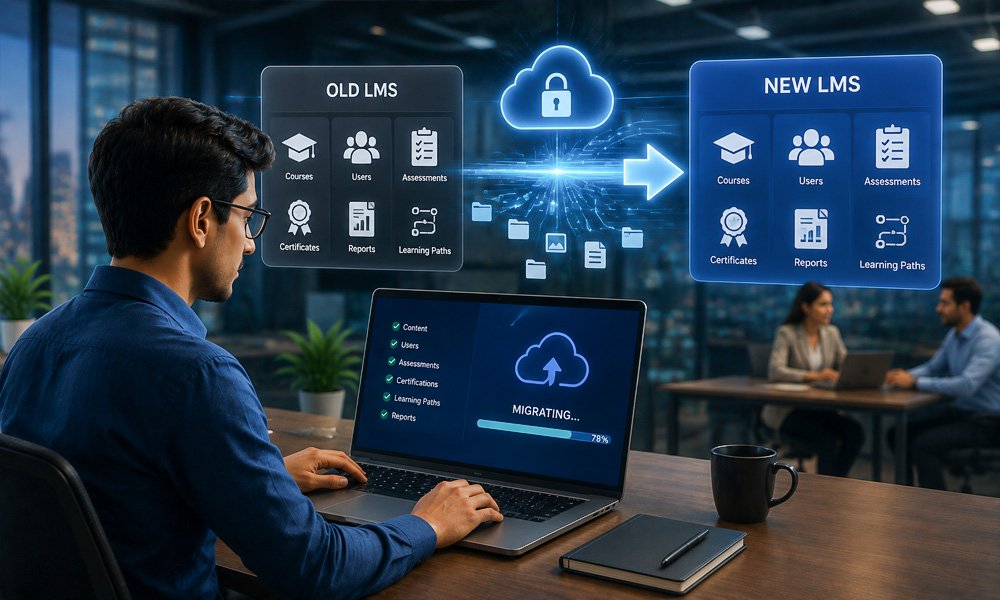
Transform Your Learning Platform Without Losing Your Learning Investment
Modern organizations continuously evolve their digital learning ecosystems to improve learner engagement, enhance reporting capabilities, support business growth, and leverage new learning technologies. As business requirements change, many organizations eventually outgrow their existing Learning Management System (LMS) or choose to adopt a more advanced platform that better aligns with their organizational goals.
However, migrating from one LMS to another is far more complex than simply transferring files. Courses, learner records, assessments, certifications, learning paths, multimedia assets, reporting data, integrations, and compliance requirements must all be carefully migrated while preserving learning continuity and minimizing disruption.
Without a structured migration strategy, organizations risk losing valuable learning history, compromising compliance records, disrupting employee training, and negatively impacting learner experiences.
At HexaLearn, we provide comprehensive LMS Course Migration Services that help organizations securely migrate learning content, learner data, assessments, certifications, and digital learning assets from one Learning Management System to another. Our structured migration methodology minimizes operational risk, protects critical learning data, and ensures your new LMS is fully functional from day one.
Whether you are migrating from a legacy LMS, upgrading to a cloud-based learning platform, consolidating multiple LMS environments, or implementing a new enterprise learning ecosystem, our migration specialists ensure a secure, validated, and seamless transition.
From initial migration assessment and data mapping to testing, validation, deployment, and post-go-live support, HexaLearn serves as your trusted migration partner throughout every phase of your LMS transformation journey.
Why LMS Course Migration Matters
Learning Management Systems have become central to corporate learning, compliance management, employee development, customer education, partner enablement, and organizational knowledge sharing. Over time, however, organizations often face challenges that require migrating to a new LMS.
Common reasons include:
- Legacy LMS Limitations
- End-Of-Life Platforms
- Cloud Migration Initiatives
- Organizational Mergers and Acquisitions
- Digital Transformation Programs
- Improved Learner Experience Requirements
- Better Reporting and Analytics
- Mobile Learning Capabilities
- AI-powered Learning Features
- Scalability for Enterprise Growth
- Compliance and Regulatory Updates
- Integration with HR, ERP, or CRM Systems
Migrating to a modern LMS provides significant business advantages, but it also introduces technical and operational complexities. Every learning asset, learner record, certification, and assessment represents valuable organizational knowledge that must be accurately preserved throughout the migration process.
A well-executed migration ensures employees continue learning without interruption while maintaining historical records required for compliance, audits, and performance management.
What Is LMS Course Migration?
LMS Course Migration is the structured process of transferring learning content, learner information, assessments, certifications, training history, and related learning assets from one Learning Management System to another.
A successful migration extends beyond moving course files. It requires careful planning, data mapping, validation, testing, and optimization to ensure that learning experiences remain consistent and business-critical information is retained.
A comprehensive LMS migration may include:
- SCORM Course Migration
- xAPI Content Migration
- AICC Package Migration
- HTML5 Learning Content Migration
- Learner Profile Migration
- User Account Migration
- Training History Migration
- Course Completion Records
- Certifications and Badges
- Learning Paths
- Curriculum Structures
- Assessments and Quizzes
- Question Banks
- Multimedia Assets
- Documents and Downloadable Resources
- Instructor-Led Training Schedules
- Virtual Classroom Configurations
- Discussion Forums
- Reporting Data
- Custom Integrations
- Single Sign-On (SSO) Configurations
- HRIS and ERP Integrations
- API Connections
- Permissions and User Roles
Our migration specialists ensure these assets are transferred accurately while maintaining system integrity and learner accessibility.
Why Choose HexaLearn for LMS Course Migration Services?
Migrating an enterprise learning environment requires expertise in instructional technologies, LMS architecture, data management, security, compliance, and project governance. At HexaLearn, we combine these capabilities to deliver structured, low-risk migration projects that help organizations transition confidently to their new learning platform.
Enterprise LMS Migration Expertise
Our team has experience supporting LMS migration initiatives across industries, helping organizations modernize learning ecosystems while protecting valuable learning investments.
We understand the complexities involved in migrating:
- Enterprise Learning Platforms
- Compliance Training Programs
- Customer Education Portals
- Partner Enablement Systems
- Employee Onboarding Programs
- Technical Training Environments
- Certification Programs
- Global Multilingual Learning Initiatives
Our proven methodologies reduce migration risks while accelerating deployment timelines.
Platform-Agnostic Migration Approach
Every organization has unique technology requirements. Rather than focusing on a single LMS, we support migrations across a wide range of enterprise and open-source learning platforms.
Our migration approach is designed to support:
- Legacy LMS to Modern LMS Migration
- Cloud-To-Cloud Migration
- On-Premise to Cloud Migration
- LMS Consolidation
- Multi-Platform Migration
- LMS Upgrades
- Enterprise Learning Modernization
This flexibility enables organizations to select the LMS that best fits their long-term learning strategy without being constrained by migration challenges.
Secure Migration Methodology
Learning data often contains confidential employee information, compliance records, certification history, and proprietary training content. Protecting this information throughout the migration process is a top priority.
Our secure migration methodology emphasizes:
- Controlled Migration Environments
- Secure Data Transfer Procedures
- Data Validation Checkpoints
- Backup and Recovery Planning
- Access Control Management
- Audit Trails
- Risk Mitigation Planning
- Rollback Strategies
These safeguards help maintain data integrity and reduce operational risks during migration.
Business-Focused Migration Strategy
Technology migration is only successful when it supports business objectives. Before initiating any migration, we work closely with stakeholders to understand:
- Organizational Learning Goals
- Compliance Obligations
- Learner Populations
- Existing System Challenges
- Integration Requirements
- Reporting Expectations
- Business Timelines
- Future Scalability Needs
This discovery process allows us to design migration strategies aligned with your operational priorities rather than applying a one-size-fits-all approach.
Minimal Downtime & Business Continuity
Training programs often support critical business operations. Extended downtime can disrupt onboarding, compliance initiatives, customer education, and workforce development.
Our migration planning focuses on:
- Phased Migration Strategies
- Controlled Deployment Windows
- Parallel Validation
- Pilot Migrations
- Incremental Rollouts
- Business Continuity Planning
- User Communication Strategies
- Go-Live Readiness
This approach helps organizations maintain learning continuity while reducing disruption during platform transitions.
Comprehensive Testing & Validation
Every migration undergoes rigorous validation before production deployment to ensure the new LMS performs as expected.
Our validation process includes:
- Course Functionality Testing
- SCORM Package Verification
- xAPI Statement Validation
- Assessment Testing
- Learner Record Verification
- Certification Validation
- Learning Path Testing
- Reporting Verification
- Integration Testing
- User Acceptance Testing (UAT)
By identifying and resolving issues before go-live, we help organizations reduce post-migration support requirements and improve learner confidence.
Benefits of Professional LMS Course Migration
A professionally managed LMS migration delivers more than a successful technical implementation—it enables organizations to modernize learning operations while protecting historical training investments.
Key benefits include:
- Secure Migration of Learning Assets
- Preservation of Learner Records
- Reduced Business Disruption
- Faster Implementation Timelines
- Improved Learner Experience
- Better Reporting Capabilities
- Support for Modern Learning Standards
- Enhanced Platform Scalability
- Simplified Compliance Management
- Lower Migration Risks
- Improved System Performance
- Greater Confidence in Enterprise-Wide Deployment
Common Challenges in LMS Migration
LMS migration projects often involve multiple systems, stakeholders, and technical dependencies. Without proper planning, organizations may encounter:
- Incompatible Course Formats
- Missing Learner Records
- Broken Assessments
- Lost Certification History
- Reporting Inconsistencies
- Integration Failures
- User Authentication Issues
- Metadata Mismatches
- Multimedia Compatibility Problems
- Extended Downtime
- Compliance Risks
- Increased Support Requests
HexaLearn addresses these challenges through structured planning, detailed data mapping, comprehensive testing, and phased migration methodologies designed to reduce complexity and improve migration success.
Our LMS Course Migration Services
HexaLearn offers end-to-end LMS migration services tailored to enterprise learning environments, ensuring a secure and efficient transition between platforms.
Our services include:
1. LMS-to-LMS Course Migration
Seamlessly transfer courses, modules, and learning paths between Learning Management Systems while preserving instructional integrity and learner experience.
2. SCORM, xAPI & AICC Migration
Migrate legacy and modern eLearning packages while ensuring compatibility, tracking accuracy, and standards compliance.
3. Learner Data Migration
Transfer user profiles, enrollment records, course completions, certifications, transcripts, and historical learning data with precision.
4. Assessment & Question Bank Migration
Move quizzes, exams, question banks, grading structures, and assessment logic without compromising learning outcomes.
5. Learning Asset Migration
Securely migrate videos, documents, presentations, downloadable resources, simulations, and multimedia content.
6. Certification & Compliance Record Migration
Preserve certifications, compliance history, badges, expiration dates, and audit-ready training records for regulatory continuity.
7. LMS Integration Migration
Reconfigure and validate integrations with HRIS, ERP, CRM, Single Sign-On (SSO), virtual classroom platforms, and third-party learning tools.
8. Migration Testing & Validation
Conduct comprehensive functional, technical, and user acceptance testing to verify migration accuracy before go-live.
9. Post-Migration Optimization & Support
Provide hypercare, issue resolution, performance optimization, and ongoing support to ensure a stable and successful transition.
Our End-to-End LMS Course Migration Process
A successful LMS migration is not simply a technical exercise—it is a strategic transformation that protects your organization's learning investment while ensuring business continuity. Every migration involves multiple components, including learning content, learner records, assessments, certifications, integrations, reporting, and platform configurations. Without a structured methodology, organizations risk data loss, compliance issues, operational disruptions, and reduced learner confidence.
At HexaLearn, we follow a proven, enterprise-grade migration framework that combines meticulous planning, rigorous validation, and phased execution. Our process minimizes risk, reduces downtime, and ensures that your new Learning Management System is fully operational and optimized from day one.
Step 1: Discovery & Migration Readiness Assessment
Every migration project begins with understanding your business objectives, learning ecosystem, and technical landscape.
Our consultants work closely with stakeholders to identify:
- Business Goals and Migration Objectives
- Existing LMS Capabilities and Limitations
- Number of Learners and User Groups
- Course Inventory and Learning Assets
- Compliance Requirements
- Reporting Needs
- Current Integrations
- Security Policies
- Migration Timelines
- Future Scalability Requirements
During this phase, we answer key questions such as:
- Why is the Organization Migrating?
- Which Learning Assets Must Be Preserved?
- What Historical Learner Data is Required?
- Are There Regulatory or Compliance Considerations?
- Which Integrations Are Business-Critical?
- What is the Acceptable Downtime Window?
- What Defines Migration Success?
This discovery phase establishes the foundation for a well-planned migration strategy tailored to your organization.
Step 2: LMS Environment Assessment
Understanding both the source and target LMS environments is critical for a successful migration.
Our technical specialists assess:
Source LMS
- Platform Architecture
- Database Structure
- Course Formats
- User Roles and Permissions
- Reporting Capabilities
- Existing Integrations
- Custom Workflows
- Learning Standards
- Security Settings
Target LMS
- Supported Learning Standards
- Data Import Capabilities
- API Availability
- User Management
- Learning Paths
- Reporting Framework
- Integration Options
- Scalability
- Compliance Features
This assessment helps identify compatibility gaps and ensures that migration activities are planned appropriately.
Step 3: Learning Content Audit
Not every course should be migrated. Over time, organizations accumulate outdated, duplicate, or unused learning content.
Our instructional and technical teams perform a comprehensive content audit to identify:
- Active Courses
- Archived Courses
- Legacy Learning Assets
- Expired Compliance Training
- Duplicate Content
- Obsolete Materials
- Multimedia Resources
- Assessments
- Question Banks
- Learning Paths
- Certifications
We categorize learning assets based on business priority, enabling organizations to migrate only content that delivers value while reducing unnecessary migration effort.
Step 4: Data Mapping & Migration Planning
Accurate data mapping is the backbone of a successful LMS migration.
Our specialists define how every data element will move from the existing platform to the new LMS.
Typical mapping includes:
User Information
- Employee IDs
- User Profiles
- Departments
- Job Roles
- Teams
- Managers
- Learning Groups
Learning Records
- Course Enrollments
- Completion History
- Progress Tracking
- Assessment Scores
- Certifications
- Learning Transcripts
- Badges
Course Assets
- SCORM Packages
- xAPI Packages
- AICC Courses
- Videos
- PDFs
- Documents
- Images
- Interactive Media
Platform Configuration
- Categories
- Learning Paths
- Permissions
- Notifications
- Reports
- Workflows
Detailed migration mapping minimizes inconsistencies and ensures information is accurately transferred.
Step 5: Migration Strategy Development
Based on the assessment, HexaLearn develops a comprehensive migration roadmap that includes:
- Migration Scope
- Milestones
- Responsibilities
- Migration Schedule
- Validation Checkpoints
- Rollback Strategy
- Communication Plan
- Risk Management Plan
- Testing Strategy
- Go-Live Approach
Organizations receive complete visibility into the migration lifecycle before implementation begins.
Step 6: Learning Content Migration
Once planning is complete, our migration specialists begin transferring learning content.
We migrate:
- eLearning Courses
- SCORM Packages
- xAPI Content
- AICC Courses
- HTML5 Learning Modules
- Videos
- Interactive Simulations
- Documents
- Learning Resources
- Attachments
During migration, every course is validated to ensure:
- Navigation Works Correctly
- Completion Tracking Functions Properly
- Multimedia Loads Successfully
- Assessments Operate as Intended
- Learning Progress is Accurately Captured
Step 7: Learner & Historical Data Migration
Preserving learner history is often one of the most critical aspects of an LMS migration.
Our migration specialists securely transfer:
- User Accounts
- Learner Profiles
- Departments
- Roles
- Enrollment History
- Completion Records
- Assessment Results
- Learning Transcripts
- Certifications
- Continuing Education Credits
- Compliance History
Maintaining accurate learner records helps organizations meet compliance obligations while ensuring a seamless learner experience.
Step 8: Assessment & Certification Migration
Assessments are central to measuring learning effectiveness and maintaining compliance.
We migrate:
- Quiz Banks
- Question Libraries
- Randomized Assessments
- Knowledge Checks
- Practical Evaluations
- Passing Criteria
- Certificates
- Digital Badges
- Certification Expiry Dates
- Renewal Schedules
Each assessment undergoes functional testing to verify scoring accuracy, feedback mechanisms, and learner progress tracking.
Step 9: Integration Migration
Modern LMS platforms typically integrate with multiple enterprise applications.
HexaLearn helps migrate and validate integrations with:
- HRIS Platforms
- ERP Systems
- CRM Applications
- Identity Providers
- Single Sign-On (SSO)
- Microsoft Teams
- Zoom
- Webex
- Virtual Classroom Solutions
- Content Libraries
- Analytics Platforms
- API-based Business Systems
Every integration is tested to ensure secure authentication, reliable data exchange, and uninterrupted business workflows.
Step 10: Testing & Quality Assurance
Migration success depends on comprehensive testing before production deployment.
Our QA process includes:
Functional Testing
- Course Launches
- Navigation
- Multimedia Playback
- Assessments
- Reporting
- Notifications
Data Validation
- User Profiles
- Completion History
- Learning Records
- Certifications
- Reports
Performance Testing
- System Responsiveness
- Concurrent Users
- Course Loading Times
- Reporting Performance
Security Testing
- User Authentication
- Role-Based Permissions
- Data Protection
- Access Controls
Integration Testing
- SSO Functionality
- HR Synchronization
- API Connectivity
- Third-Party Applications
Rigorous testing ensures the migrated environment meets functional, technical, and business requirements.
Step 11: User Acceptance Testing (UAT)
Before production deployment, stakeholders validate the migrated environment through User Acceptance Testing.
Typical UAT activities include:
- Reviewing Migrated Courses
- Validating Learner Records
- Testing Reports
- Verifying Assessments
- Confirming Certifications
- Checking Integrations
- Reviewing User Permissions
- Evaluating Learner Experience
Any issues identified during UAT are resolved before the final go-live.
Step 12: Production Deployment & Go-Live
Once testing is complete, HexaLearn executes the production migration using a carefully managed deployment plan.
Our go-live activities include:
- Final Data Synchronization
- Production Deployment
- DNS Updates (Where Applicable)
- User Provisioning
- Integration Activation
- System Monitoring
- Communication with Stakeholders
- Production Validation
Our phased deployment strategy minimizes operational disruption and supports business continuity.
Step 13: Hypercare & Post-Migration Support
Migration does not end at go-live. The first few weeks are critical for ensuring adoption and operational stability.
Our post-migration support includes:
- Dedicated Hypercare
- Issue Resolution
- Performance Optimization
- User Assistance
- Bug Fixes
- Reporting Validation
- Integration Monitoring
- Knowledge Transfer
- Administrator Support
- Continuous Optimization Recommendations
This ensures your organization quickly realizes the benefits of the new LMS while maintaining learner confidence.
Learning Standards We Support
To ensure compatibility across diverse Learning Management Systems, HexaLearn supports industry-recognized eLearning standards.
SCORM 1.2
Supports legacy course migration while maintaining learner tracking, completion status, and reporting.
SCORM 2004
Preserves advanced sequencing, navigation rules, learner interactions, and detailed completion tracking.
xAPI (Tin Can API)
Enables migration of modern learning experiences, including mobile learning, simulations, offline learning, and experiential training with detailed learning analytics.
AICC
Supports organizations maintaining legacy aviation and compliance-based training environments that still rely on AICC-compatible content.
cmi5
Facilitates migration to next-generation learning ecosystems by combining the flexibility of xAPI with LMS-managed learning experiences.
Enterprise LMS Platforms We Support
Our migration expertise spans a broad range of commercial, open-source, and cloud-based Learning Management Systems, including:
- Moodle
- Totara Learn
- Cornerstone Ondemand
- SAP Successfactors Learning
- Docebo
- Blackboard Learn
- Canvas LMS
- Talentlms
- Litmos
- Learnupon
- Absorb LMS
- Oracle Learning
- Saba Cloud
- D2L Brightspace
- Open Edx
- Ispring Learn
- Adobe Learning Manager
- Custom LMS Platforms
Whether you're migrating between similar platforms or transitioning from a legacy system to a modern cloud-based LMS, HexaLearn delivers a structured, secure, and scalable migration approach tailored to your organization's learning and business objectives.
Enterprise LMS Migration Expertise, Security, Industries & Why Organizations Trust HexaLearn
Enterprise LMS Migration Solutions for Every Industry
Every industry has unique learning objectives, compliance obligations, security standards, and workforce development requirements. A successful LMS migration must preserve these business-critical elements while ensuring a smooth transition to the new learning platform.
At HexaLearn, we tailor our LMS migration approach to meet the operational, regulatory, and technical needs of each industry. Our migration specialists work closely with learning teams, IT departments, compliance officers, and business stakeholders to ensure learning continuity throughout the migration journey.
Manufacturing
Manufacturing organizations depend on continuous workforce training to maintain operational efficiency, workplace safety, product quality, and regulatory compliance.
Our LMS migration services support:
- Safety Training Records
- Standard Operating Procedures (SOPs)
- Equipment Operation Training
- Machine Certification Programs
- Lean Manufacturing
- Six Sigma Training
- Quality Management Courses
- Production Onboarding
- Technical Skills Development
- Contractor Training
We ensure that historical certifications, recurring compliance schedules, and production-critical learning paths remain intact during migration.
Healthcare & Life Sciences
Healthcare organizations require secure migration of learning records while complying with strict regulatory standards.
We help migrate:
- Clinical Training
- Patient Safety Programs
- Medical Device Training
- Continuing Medical Education (CME)
- Infection Control
- HIPAA Awareness Programs
- Good Manufacturing Practices (GMP)
- Pharmacovigilance
- Laboratory Training
- Compliance Certifications
Our structured validation process helps maintain training integrity for audits and regulatory inspections.
Banking, Financial Services & Insurance (BFSI)
Financial institutions operate in highly regulated environments where learner records and certification histories must be accurately maintained.
Our migration expertise covers:
- Anti-Money Laundering (AML)
- Know Your Customer (KYC)
- Risk Management
- Cybersecurity Awareness
- Information Security
- Regulatory Compliance
- Financial Product Training
- Customer Service Learning
- Sales Enablement
- Leadership Development
We ensure compliance training records remain complete and audit-ready after migration.
Information Technology
Technology organizations require agile learning platforms that support continuous upskilling and certification.
We migrate:
- Software Product Training
- Technical Certifications
- Cloud Computing Courses
- Artificial Intelligence Learning
- Cybersecurity Programs
- Devops Training
- Programming Courses
- Agile Methodologies
- Product Onboarding
- Customer Enablement Portals
Our migration approach supports frequent platform updates and evolving learning ecosystems.
Retail & E-Commerce
Retail businesses require scalable learning platforms that support geographically distributed teams.
Migration projects commonly include:
- Store Onboarding
- Product Knowledge
- Customer Experience Training
- Sales Enablement
- Visual Merchandising
- Inventory Management
- POS System Training
- Seasonal Learning Campaigns
- Compliance Programs
- Franchise Learning
We help maintain uninterrupted employee learning during peak business periods.
Education & Higher Learning
Educational institutions require migration of both academic and administrative learning content.
Our services support:
- Online Degree Programs
- Faculty Development
- Student Learning
- Virtual Classrooms
- Blended Learning
- Digital Curriculum
- Assessments
- Learning Analytics
- Student Transcripts
- Accreditation Requirements
We ensure minimal disruption to students and educators during migration.
Government & Public Sector
Government organizations require secure, compliant, and transparent migration processes.
Our migration capabilities include:
- Employee Development
- Public Administration Training
- Policy Education
- Compliance Learning
- Leadership Programs
- Citizen Service Training
- Security Awareness
- Regulatory Certifications
We emphasize governance, auditability, and data security throughout every migration project.
Additional Industries We Support
HexaLearn also provides LMS migration services for organizations in:
- Pharmaceuticals
- Telecommunications
- Energy & Utilities
- Logistics & Supply Chain
- Hospitality
- Aviation
- Automotive
- Construction
- Professional Services
- Non-Profit Organizations
Enterprise Security Throughout the Migration Lifecycle
Learning Management Systems often contain confidential organizational information, employee records, intellectual property, and regulatory documentation. Protecting this information is essential during every migration activity.
HexaLearn follows a security-first migration methodology designed to safeguard learning data throughout the project lifecycle.
Our security practices include:
- Secure Migration Environments
- Encrypted Data Transfers
- Controlled System Access
- Role-Based Permissions
- Secure Authentication
- Backup Verification
- Audit Logging
- Data Integrity Validation
- Controlled Production Deployment
- Post-Migration Security Verification
These practices help organizations reduce operational risks while protecting sensitive learning information.
Compliance-Focused LMS Migration
Many organizations must maintain historical learning records to satisfy legal, regulatory, and industry-specific compliance requirements.
HexaLearn helps preserve:
- Compliance Training History
- Employee Certifications
- Mandatory Learning Records
- Audit Documentation
- Regulatory Reporting
- Assessment History
- Expiration Dates
- Recertification Schedules
- Continuing Education Records
Our migration methodology supports organizations operating under industry regulations while helping maintain compliance continuity.
Data Validation & Quality Assurance
Migrating information successfully means more than transferring data—it requires validating that every record is complete, accurate, and functional in the new LMS.
Our quality assurance framework includes multiple validation checkpoints throughout the migration lifecycle.
Course Validation
We verify:
- Course Launches
- Navigation
- Completion Tracking
- Multimedia Functionality
- Interactive Elements
- SCORM Communication
- xAPI Tracking
- Mobile Compatibility
Learner Data Validation
We verify:
- User Accounts
- Learning History
- Enrollment Status
- Course Completions
- Assessment Scores
- Certifications
- Badges
- Learning Transcripts
Assessment Validation
Our specialists test:
- Question Banks
- Quiz Logic
- Randomization
- Passing Scores
- Feedback
- Attempts
- Scoring Calculations
Reporting Validation
We validate:
- Completion Reports
- Compliance Reports
- Learning Dashboards
- User Activity
- Course Analytics
- Certification Reports
- Manager Reports
Integration Validation
Every enterprise integration undergoes detailed verification, including:
- HRIS Synchronization
- Single Sign-On (SSO)
- API Communication
- ERP Integration
- CRM Connectivity
- Virtual Classroom Integrations
This comprehensive validation process reduces post-migration issues and ensures operational readiness.
Enterprise Risk Mitigation Strategy
Every LMS migration introduces technical and operational risks. Our structured governance model helps organizations identify, monitor, and mitigate these risks throughout the project.
Common risks include:
- Data Loss
- Learning Interruptions
- Integration Failures
- Course Incompatibility
- Compliance Gaps
- User Authentication Issues
- Performance Degradation
- Reporting Inconsistencies
- Schedule Delays
- Stakeholder Misalignment
HexaLearn proactively addresses these risks through:
- Detailed Planning
- Pilot Migrations
- Backup Procedures
- Rollback Planning
- Parallel Testing
- Quality Checkpoints
- Executive Reporting
- Continuous Monitoring
This disciplined approach significantly reduces migration uncertainty and improves project outcomes.
Business Continuity During LMS Migration
One of the biggest concerns during an LMS migration is maintaining uninterrupted learning operations.
Our migration methodology supports business continuity by incorporating:
- Phased Migrations
- Controlled Cutover Windows
- Incremental Deployments
- Parallel Platform Availability
- Learner Communication Plans
- Administrator Training
- Hypercare Support
- Go-Live Monitoring
These measures help organizations continue delivering critical training with minimal disruption.
Why Organizations Trust HexaLearn
Organizations choose HexaLearn because we combine technical expertise, instructional design knowledge, and enterprise project management to deliver secure, scalable, and business-focused LMS migration services.
Migration Expertise
Our specialists understand the technical and operational complexities of migrating enterprise learning environments across diverse LMS platforms.
Business-Centric Approach
Every migration strategy is aligned with organizational goals, compliance requirements, learner needs, and long-term digital learning objectives.
Platform Independence
We provide unbiased migration services across a wide range of commercial, open-source, cloud-based, and custom Learning Management Systems.
Structured Project Governance
Every project is managed using clearly defined milestones, communication plans, quality checkpoints, and stakeholder reviews to ensure transparency and accountability.
Quality-Driven Delivery
Our rigorous testing and validation processes help ensure that learning content, learner records, integrations, and reporting function correctly before production deployment.
Security & Compliance Focus
We prioritize data protection, secure migration practices, and compliance preservation throughout every phase of the migration lifecycle.
Scalable Enterprise Support
Whether migrating a few hundred learners or supporting enterprise-wide implementations across multiple business units and geographies, our methodology scales to meet evolving organizational needs.
Benefits of Partnering with HexaLearn
Working with HexaLearn provides organizations with a trusted partner capable of managing complex LMS migration initiatives while minimizing business disruption.
Key advantages include:
- End-To-End Migration Management
- Platform-Agnostic Expertise
- Preservation of Learning Investments
- Reduced Migration Risks
- Secure Handling of Learner Data
- Comprehensive Validation and Testing
- Business Continuity Planning
- Minimal Operational Downtime
- Compliance-Focused Migration Approach
- Enterprise-Scale Project Delivery
- Post-Go-Live Support and Optimization
- Long-Term Partnership for Learning Transformation
Future-Ready LMS Migration
A successful migration should not only replicate the existing learning environment but also prepare organizations for future growth and innovation.
HexaLearn helps organizations modernize their learning ecosystems by enabling:
- Cloud-Based Learning Environments
- Mobile Learning Experiences
- AI-powered Learning Capabilities
- Advanced Analytics and Reporting
- Personalized Learning Journeys
- Scalable Enterprise Training
- Enhanced Learner Engagement
- Integration with Modern HR and Business Systems
- Improved Administrator Productivity
- Greater Flexibility for Future Learning Initiatives
By combining secure migration practices with strategic modernization, we help organizations maximize the value of their new Learning Management System and build a strong foundation for long-term digital learning success.
Flexible Engagement Models
Every organization has unique migration requirements depending on the size of its LMS environment, number of learners, compliance obligations, and project timelines. At HexaLearn, we offer flexible engagement models that allow organizations to choose the approach that best aligns with their business objectives and budget.
Fixed Price Model
Ideal for organizations with clearly defined migration requirements, timelines, and deliverables.
Best suited for:
- Small to Medium LMS Migrations
- Standard LMS Upgrades
- Single Platform Migration
- Course Migration Projects
- Compliance Learning Migration
Benefits include:
- Predictable Project Cost
- Clearly Defined Scope
- Fixed Timelines
- Milestone-Based Delivery
- Reduced Project Risk
Time & Material Model
Suitable for projects where migration requirements evolve during execution.
Recommended for:
- Enterprise Digital Transformation
- Complex Integrations
- Legacy LMS Modernization
- Multi-Country Implementations
- Continuous Migration Initiatives
Benefits include:
- Greater Flexibility
- Agile Execution
- Iterative Improvements
- Easy Scope Adjustments
- Continuous Optimization
Dedicated Migration Team
A dedicated team works exclusively on your migration project.
Your team may include:
- Project Manager
- LMS Consultant
- Solution Architect
- Migration Specialist
- LMS Administrator
- QA Engineer
- Instructional Designer
- Integration Specialist
- Technical Support Engineer
Ideal for:
- Large Enterprises
- Multi-LMS Migration
- Global Organizations
- Long-Term Modernization Initiatives
Hybrid Engagement Model
Combines the predictability of fixed-price delivery with the flexibility of Time & Material engagements.
Suitable for:
- Enterprise Migration Programs
- Multi-Phase LMS Implementation
- Global Rollout Initiatives
- Continuous Platform Optimization
Our Project Onboarding Process
A successful migration begins with a structured onboarding process that establishes project governance, communication, and technical readiness.
Step 1 – Initial Consultation
We understand:
- Current LMS
- Target LMS
- Business Objectives
- Learning Ecosystem
- Technical Requirements
- Compliance Obligations
Step 2 – Migration Assessment
Our specialists evaluate:
- Existing Courses
- Learning Assets
- Learner Data
- Integrations
- Reports
- Customizations
- Security Requirements
Step 3 – Migration Roadmap
We prepare:
- Migration Strategy
- Project Milestones
- Resource Allocation
- Migration Schedule
- Risk Assessment
- Validation Plan
Step 4 – Statement of Work (SoW)
The SoW defines:
- Scope
- Deliverables
- Responsibilities
- Timelines
- Acceptance Criteria
- Communication Plan
Step 5 – Project Kick-Off
During kick-off we:
- Introduce Project Teams
- Finalize Communication Channels
- Confirm Timelines
- Review Governance
- Establish Reporting Cadence
Step 6 – Migration Execution
Migration activities begin according to the approved roadmap.
Step 7 – Validation & Go-Live
Following successful testing, the production environment is launched with controlled deployment and post-go-live monitoring.
Complimentary LMS Migration Assessment
Choosing the right migration partner is a critical decision. To help organizations evaluate migration complexity and prepare for a successful transition, HexaLearn offers a complimentary LMS Migration Assessment for qualified opportunities.
Our assessment includes:
- Existing LMS Review
- Course Inventory Analysis
- Learning Standards Compatibility (SCORM, xAPI, AICC, Cmi5)
- Learner Data Assessment
- Integration Review
- Migration Risk Analysis
- High-Level Migration Roadmap
- Estimated Effort and Timeline
- Recommendations for Optimization
This assessment provides valuable insights into your migration readiness and helps identify potential challenges before the project begins.
Related HexaLearn Services
Our LMS Course Migration Services integrate seamlessly with our broader digital learning and technology capabilities.
Related services include:
- Custom eLearning Development
- Rapid eLearning Development
- eLearning Content Development
- Instructional Design Services
- LMS Development & Customization
- LMS Integration Services
- Learning Experience Design (LXD)
- SCORM Conversion Services
- Legacy Flash to HTML5 Conversion
- eLearning Translation & Localization
- Learning Consulting
- AI-Powered eLearning Solutions
- Mobile Learning Development
- Microlearning Development
- Video-Based Learning
- Gamification Solutions
- Software Simulations
- LMS Support & Maintenance
Frequently Asked Questions (FAQs)
1. What is LMS Course Migration?
LMS Course Migration is the process of securely transferring courses, learner records, assessments, certifications, reports, and learning assets from one Learning Management System to another while preserving learning integrity and minimizing business disruption.
2. Why should organizations migrate to a new LMS?
Organizations typically migrate to improve scalability, user experience, reporting capabilities, integration options, security, cloud adoption, and support for modern learning technologies.
3. Which LMS platforms do you support?
HexaLearn supports migrations across major platforms including Moodle, Totara, SAP SuccessFactors, Cornerstone, Docebo, Canvas, Blackboard, LearnUpon, Litmos, TalentLMS, Absorb LMS, Oracle Learning, Adobe Learning Manager, Open edX, and custom LMS platforms.
4. Can you migrate SCORM, xAPI, and AICC courses?
Yes. We support migration of SCORM 1.2, SCORM 2004, xAPI (Tin Can API), AICC, HTML5, and cmi5-compatible learning content.
5. Will learner history be preserved?
Yes. We migrate learner profiles, enrollments, course completions, assessment results, certifications, transcripts, badges, and historical learning records based on the capabilities of the source and target LMS.
6. How do you minimize downtime during migration?
We use phased migration strategies, pilot testing, parallel validation, controlled deployment windows, and business continuity planning to reduce operational disruption.
7. How do you ensure data security?
Our migration process includes secure data transfer, role-based access controls, encrypted environments, validation checkpoints, backup strategies, and controlled deployment procedures.
8. Do you migrate integrations?
Yes. We can assist with reconfiguring and validating integrations such as HRIS, ERP, CRM, Single Sign-On (SSO), APIs, and virtual classroom platforms, subject to platform capabilities.
9. How long does an LMS migration project take?
Project duration depends on factors such as the number of courses, learner records, integrations, customizations, and review cycles. After the migration assessment, we provide a detailed implementation plan with estimated timelines.
10. Do you provide post-migration support?
Yes. We provide hypercare, issue resolution, administrator support, performance monitoring, and optimization after go-live.
11. Can you migrate multilingual learning content?
Yes. We support multilingual learning environments and help preserve localized learning content where supported by the source and target platforms.
12. Do you provide migration testing?
Yes. Our quality assurance process includes functional testing, data validation, integration testing, reporting verification, security validation, and User Acceptance Testing (UAT).
13. Why choose HexaLearn?
Organizations choose HexaLearn because of our platform-independent expertise, structured migration methodology, enterprise project governance, security-first approach, comprehensive validation process, and commitment to minimizing migration risks while ensuring business continuity.
Ready to Modernize Your Learning Management System?
Migrating to a new Learning Management System is more than a technical upgrade—it is an opportunity to enhance learner experiences, improve operational efficiency, strengthen compliance, and future-proof your organization's learning ecosystem.
Whether you're replacing a legacy LMS, consolidating multiple platforms, moving to the cloud, or implementing a modern enterprise learning solution, HexaLearn provides the expertise, governance, and technical capabilities to ensure a secure and successful migration.
Our structured migration methodology helps organizations protect valuable learning investments, preserve historical learner data, minimize downtime, and maximize the value of their new LMS.
Request a Free LMS Migration Consultation
Planning an LMS migration?
Our specialists can help you:
- Assess Your Current LMS Environment
- Review Learning Content and Learner Records
- Evaluate Migration Complexity
- Identify Risks and Dependencies
- Recommend the Right Migration Strategy
- Estimate Timelines and Effort
- Develop a Migration Roadmap
Schedule a complimentary consultation and discover how HexaLearn can help you migrate with confidence.
Let's Make Your LMS Migration Secure, Seamless, and Successful
Whether you're migrating hundreds of courses or managing a large-scale enterprise LMS transformation, HexaLearn is your trusted migration partner.
Why HexaLearn?
HexaLearn is more than an LMS migration provider—we are a strategic learning technology partner. Our expertise spans Learning Management Systems, instructional design, digital learning technologies, enterprise integrations, and learning transformation initiatives.
By combining structured project governance, secure migration practices, comprehensive validation, and a business-first approach, we help organizations transition confidently to modern learning platforms while protecting their existing learning investments.
Whether you're migrating compliance training, employee onboarding, customer education, or enterprise learning ecosystems, HexaLearn delivers secure, scalable, and future-ready LMS migration solutions.
Final Conclusion
A successful LMS migration requires more than moving content from one platform to another. It demands careful planning, technical expertise, data validation, security, governance, and a clear understanding of organizational learning objectives.
At HexaLearn, we provide end-to-end LMS Course Migration Services that help organizations modernize their learning ecosystems while minimizing risk, preserving learning history, and maintaining business continuity. From migration assessment and data mapping to testing, deployment, and post-go-live support, our structured methodology ensures a smooth transition and long-term success.
Partner with HexaLearn to migrate your learning platform with confidence, enabling a secure, scalable, and future-ready digital learning environment that supports your workforce today and adapts to your business needs tomorrow.
Schedule a demo with our eLearning experts.