

LMS Testing Services in India for Reliable, Secure, and Seamless Learning Experiences
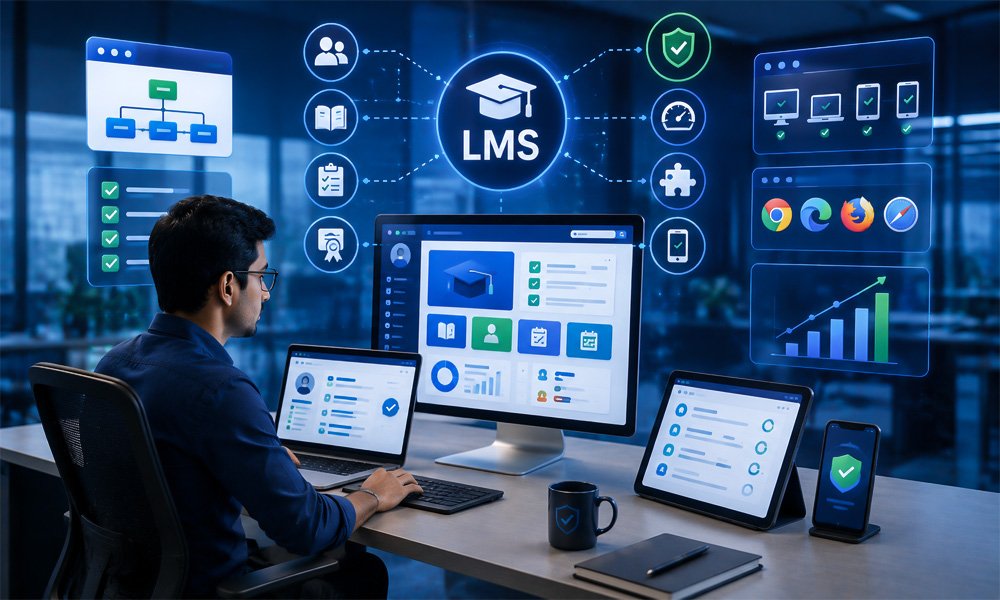
A learning management system is at the center of modern digital learning programs. It manages courses, learners, assessments, certifications, progress, reporting, learning paths, integrations, and user access. When an LMS does not perform as expected, the impact can extend far beyond a technical issue it can disrupt training operations and negatively affect the learner experience.
At HexaLearn, we provide comprehensive LMS Testing Services in India to help organizations validate the functionality, performance, usability, compatibility, security, integrations, and reliability of their learning platforms.
Our LMS quality assurance approach covers the complete learning ecosystem—from user registration and course enrollment to content delivery, assessments, tracking, reporting, certificates, integrations, and Mobile Learning
Whether you are implementing a new LMS, upgrading an existing platform, migrating from one LMS to another, or maintaining a large enterprise learning environment, our testing team can help identify issues before they affect your users.
Why LMS Testing Matters
An LMS is much more than a website that displays courses.
It can connect multiple systems and support thousands of users, courses, learning activities, assessments, reports, and business processes.
A defect in one area can create problems across the learning ecosystem.
For example:
- Learners may be unable to access assigned courses.
- Course completion may not be recorded correctly.
- SCORM packages may fail to communicate with the LMS.
- Assessment scores may be reported incorrectly.
- Certificates may not be generated.
- Managers may receive inaccurate training reports.
- Mobile users may experience broken layouts.
- Integrations may fail to synchronize data.
- Users may receive incorrect permissions.
- High traffic may cause slow page response.
- Authentication problems may prevent users from accessing training.
- Learning progress may be lost.
Comprehensive LMS testing helps identify these issues before they affect learners and administrators.
Our LMS Testing Services
HexaLearn provides structured LMS quality assurance services designed around your platform, users, learning content, integrations, and business requirements.
1. LMS Functional Testing
Functional testing verifies whether the LMS works according to its functional requirements.
We test the complete user journey and individual LMS features.
Testing can cover:
- User registration
- Login and logout
- Password management
- User profiles
- Course catalog
- Course enrollment
- Course access
- Course completion
- Learning paths
- Assessments
- Certifications
- Notifications
- Search
- Dashboards
- Reports
- User management
- Content management
- Administrative functions
We validate both normal and negative scenarios to identify unexpected behavior.
2. Course Delivery Testing
The primary purpose of an LMS is to deliver learning experiences effectively.
Our course delivery testing evaluates whether learners can access and complete assigned learning content correctly.
We can test:
- Course launch
- Course navigation
- Content accessibility
- Course sequencing
- Prerequisites
- Completion rules
- Learning paths
- Course availability
- Course expiration
- Progress tracking
- Resume behavior
- Course bookmarking
- Course completion
Testing is performed according to the learning rules and configuration defined for your LMS.
3. SCORM Testing
SCORM remains a widely used standard for packaging and tracking eLearning content.
Our SCORM testing validates communication between the learning content and LMS.
We can test:
- SCORM package upload
- Course launch
- Completion status
- Success status
- Score reporting
- Bookmarking
- Resume functionality
- Suspend data
- Session handling
- Course exit
- Assessment results
- Completion conditions
- Re-launch behavior
SCORM testing helps ensure that learners receive credit for completed learning activities and that administrators receive accurate training data.
4. xAPI Testing
Organizations using xAPI can capture learning experiences beyond traditional LMS activities.
Our xAPI testing can validate:
- Statement generation
- Actor information
- Verb information
- Object information
- Result data
- Context information
- Completion data
- Score information
- Learning Record Store communication
- Statement consistency
Testing helps ensure that learning activity data is captured and transmitted as intended.
5. User Role and Permission Testing
LMS platforms commonly support multiple user roles.
For example:
- Learners
- Instructors
- Managers
- Administrators
- Course authors
- Super administrators
Each role may have different permissions.
Our testing validates whether users can access only the functions and information permitted for their role.
We test:
- Role assignment
- Permission settings
- Course access
- Administrative functions
- User management
- Reporting access
- Content management
- Assessment management
- Configuration permissions
This helps reduce the risk of unauthorized access or accidental modification of LMS data.
6. User Registration and Authentication Testing
The learner journey often begins with account creation or authentication.
We test:
- Registration
- Login
- Logout
- Password reset
- Password policies
- Account activation
- Account deactivation
- Single sign-on where applicable
- Session management
- Authentication errors
- Unauthorized access
Where the LMS uses enterprise identity systems, testing can also cover the expected authentication workflow.
7. Course Enrollment Testing
Course enrollment is a fundamental LMS workflow.
We validate different enrollment scenarios, including:
- Self-enrollment
- Administrator enrollment
- Manager enrollment
- Group enrollment
- Bulk enrollment
- Automatic enrollment
- Enrollment through learning paths
- Enrollment through integrations
- Prerequisite-based enrollment
We also verify whether enrollment status and course access are updated correctly.
8. Assessment and Quiz Testing
Assessments help organizations measure learner understanding and determine course completion.
Our assessment testing covers:
- Question display
- Answer selection
- Multiple-choice questions
- Multiple-response questions
- True/false questions
- Matching questions
- Randomized questions
- Question banks
- Scoring
- Passing scores
- Attempts
- Retry rules
- Feedback
- Review functionality
- Completion rules
- Assessment reporting
We verify that assessment results are calculated and recorded correctly.
9. Certification Testing
Many organizations use LMS platforms to issue certificates after learners complete specific requirements.
We test:
- Certificate eligibility
- Completion requirements
- Certificate generation
- Certificate availability
- Certificate data
- Expiration rules
- Renewal requirements
- Certificate downloads
- Certificate records
- User access
This helps ensure that learners receive accurate certification information.
10. LMS Reporting Testing
LMS reports are often used by learning and development teams, managers, administrators, and business stakeholders.
Incorrect reports can lead to poor training decisions.
Our reporting tests can validate:
- Course completion
- Learner progress
- Assessment scores
- Training hours
- Enrollment data
- Certification status
- User activity
- Learning paths
- Compliance status
- Export functionality
- Filters
- Date ranges
- Report permissions
We compare report outputs against expected data to identify inconsistencies.
11. LMS Integration Testing
Modern LMS platforms often integrate with other enterprise systems.
Examples include:
- HR systems
- HRIS platforms
- CRM systems
- ERP systems
- Identity providers
- Payment systems
- Content repositories
- Video platforms
- Analytics platforms
- Third-party applications
- Learning content providers
Our integration testing validates data exchange and workflow behavior between the LMS and connected systems.
We can test:
- Data synchronization
- User creation
- User updates
- Course information
- Enrollment data
- Completion data
- Authentication
- API communication
- Error handling
- Synchronization schedules
12. API Testing for LMS Platforms
APIs can support critical LMS functionality.
They may be used to exchange:
- User information
- Course data
- Enrollment records
- Progress
- Assessment results
- Completion information
- Reports
Our API testing can validate LMS API functionality, integration behavior, authentication, response data, and error handling.
For broader API requirements, our API Testing Services can complement LMS quality assurance.
13. LMS Performance Testing
An LMS must remain responsive when many users access it simultaneously.
Performance testing helps determine whether the platform can handle expected traffic.
We can evaluate:
- Page response time
- Course launch time
- Concurrent users
- Login performance
- Search performance
- Dashboard performance
- Report generation
- Assessment submission
- Database response
- Server resource utilization
- System stability
Testing can be performed under different workload scenarios based on your expected usage.
14. LMS Load Testing
Load testing evaluates LMS behavior under expected user volumes.
For example, an enterprise organization may need to support thousands of employees accessing mandatory training during a short period.
Load testing can help evaluate:
- Concurrent login activity
- Course launches
- Assessment submissions
- Report generation
- Search activity
- Content access
- API requests
The results can help identify performance bottlenecks before major training campaigns.
15. LMS Stress Testing
Stress testing examines how the LMS behaves when the system is pushed beyond expected capacity.
It can help identify:
- Performance degradation
- Failure points
- Resource limitations
- Recovery behavior
- Stability issues
- Scalability concerns
This information can support infrastructure and capacity planning.
16. Mobile LMS Testing
Learners increasingly access training through smartphones and tablets.
Our mobile LMS testing validates the learning experience across supported mobile devices and screen sizes.
We test:
- Mobile login
- Navigation
- Course access
- Responsive layouts
- Assessments
- Videos
- Audio
- Downloads
- Touch interactions
- Scrolling
- Orientation changes
- Progress tracking
- Mobile-specific behavior
The exact device coverage can be customized according to your learner population.
17. Browser Compatibility Testing
Different browsers can produce different behaviors.
We test LMS functionality across the browsers specified in your requirements.
Testing may cover:
- Login
- Navigation
- Course launch
- Assessments
- Reports
- Dashboards
- Multimedia
- File uploads
- Downloads
- Responsive layouts
- JavaScript functionality
Browser coverage can be based on your organization's supported browsers and learner analytics.
18. Responsive Testing
Responsive testing verifies how the LMS adapts to different screen sizes.
We look for:
- Text overflow
- Overlapping elements
- Broken menus
- Misaligned controls
- Incorrect scaling
- Horizontal scrolling
- Cut-off content
- Navigation problems
- Touch interaction issues
This helps provide a consistent learning experience across supported devices.
19. LMS Usability Testing
An LMS may be technically functional but still difficult to use.
Usability testing evaluates the platform from the perspective of learners, instructors, managers, and administrators.
We assess:
- Navigation
- Search
- Course discovery
- Dashboard usability
- Menu structure
- Instructions
- Button placement
- Information hierarchy
- Progress visibility
- Assessment experience
- Error messages
- Overall user experience
The objective is to make the learning platform intuitive and easy to navigate.
20. LMS Security Testing
Security is a critical consideration for platforms containing learner information, employee data, training records, and business information.
Our security testing can cover areas such as:
- Authentication
- Authorization
- Role permissions
- Session management
- Access control
- Password functionality
- Unauthorized access
- Input validation
- File upload controls
- Sensitive data exposure
- API access
Security testing should be aligned with your organization's security requirements and applicable standards.
21. Accessibility Testing
An inclusive LMS should be usable by learners with different accessibility needs.
Our accessibility testing can evaluate:
- Keyboard navigation
- Focus order
- Focus visibility
- Screen reader compatibility
- Alternative text
- Color contrast
- Accessible forms
- Accessible controls
- Captions
- Transcripts
- Text readability
Testing scope can be aligned with the accessibility requirements relevant to your organization and target audience.
22. Notification and Email Testing
LMS platforms may send automated notifications for different events.
We test:
- Enrollment emails
- Course assignment notifications
- Course reminders
- Assessment notifications
- Completion emails
- Certification notifications
- Password reset emails
- Administrative notifications
We verify the trigger, recipient, content, links, and timing according to the defined requirements.
23. Search and Course Catalog Testing
A large LMS can contain hundreds or thousands of learning resources.
Search and catalog functionality therefore becomes important to the learner experience.
We test:
- Keyword search
- Filters
- Categories
- Sorting
- Search suggestions
- Course availability
- Search results
- No-result behavior
- Course details
- Enrollment from search results
This helps learners find the right content efficiently.
24. Data Migration Testing
Organizations often migrate learning content and learner information when moving to a new LMS.
Migration testing validates whether the required information has transferred accurately.
Testing can cover:
- User accounts
- Course information
- Enrollment data
- Completion records
- Assessment results
- Certificates
- Learning history
- Course metadata
- Learning paths
We compare migrated data with source information to identify discrepancies.
25. LMS Upgrade and Regression Testing
LMS platforms are frequently updated.
New versions can introduce changes to existing functionality.
Our regression testing helps verify that critical workflows continue to operate after:
- LMS upgrades
- Configuration changes
- Plugin updates
- Integration changes
- Content updates
- Security patches
- Infrastructure changes
Regression testing can be partially or fully automated depending on the LMS architecture.
Our LMS Testing Process
We follow a structured QA process designed around the LMS architecture and business requirements.
Step 1: Requirement Analysis
We review the LMS requirements, user roles, workflows, integrations, learning content, technical architecture, supported devices, and business objectives.
Relevant documentation may include:
- Functional requirements
- User stories
- LMS specifications
- Process documentation
- Integration specifications
- Course requirements
- Accessibility requirements
- Security requirements
Step 2: Test Strategy
We determine the appropriate testing scope based on the platform and business risks.
The strategy may include:
- Functional testing
- Integration testing
- Performance testing
- Security testing
- Usability testing
- Accessibility testing
- Compatibility testing
- SCORM testing
- xAPI testing
- Regression testing
Step 3: Test Case Design
We create test scenarios covering different LMS users and workflows.
Test cases can include:
- Learner workflows
- Administrator workflows
- Instructor workflows
- Manager workflows
- Course workflows
- Assessment workflows
- Reporting workflows
- Integration workflows
Step 4: Environment Preparation
We prepare the required testing environment, test accounts, courses, devices, browsers, integrations, and test data.
Step 5: Test Execution
The QA team executes test cases and validates actual results against expected behavior.
Issues are documented as they are identified.
Step 6: Defect Reporting
Defects are recorded with relevant information such as:
- Issue description
- Steps to reproduce
- Expected behavior
- Actual behavior
- User role
- Browser/device
- LMS environment
- Severity
- Supporting screenshots or recordings
Step 7: Defect Retesting
After fixes are implemented, we verify that the reported issue has been resolved.
Step 8: Regression Testing
Related functionality is tested to ensure that fixes or updates have not created new issues.
Step 9: Final QA Reporting
The final report can include:
- Test coverage
- Test execution results
- Passed and failed cases
- Defect summary
- Outstanding issues
- Environment details
- Recommendations
LMS Testing for Different User Roles
An LMS should be tested from the perspective of every important user group.
Learner Testing
We validate:
- Login
- Course discovery
- Enrollment
- Course access
- Navigation
- Assessments
- Progress
- Completion
- Certificates
- Notifications
Instructor Testing
We test:
- Course creation
- Content management
- Learner management
- Assessments
- Grading
- Reports
- Communication
Manager Testing
Manager workflows can include:
- Team management
- Learner progress
- Training assignments
- Reports
- Completion monitoring
Administrator Testing
Administrative testing may cover:
- User management
- Roles
- Permissions
- Course management
- System settings
- Reports
- Integrations
- Configuration
LMS Testing Tools and Technologies
Testing tools should be selected according to the LMS architecture and testing objectives.
Depending on the project, testing may involve:
- Browser testing tools
- API testing tools
- Performance testing tools
- Automation frameworks
- Database validation tools
- Accessibility testing tools
- SCORM testing environments
- xAPI testing tools
- Mobile device testing environments
Common technologies may include API testing platforms such as Postman, performance testing tools such as JMeter, and browser automation frameworks where applicable.
Benefits of Professional LMS Testing
Better Learner Experience
Testing helps ensure that learners can navigate and complete training without unnecessary technical problems.
Improved LMS Reliability
Comprehensive testing identifies functional and integration issues before they affect users.
More Accurate Learning Data
Testing tracking, reporting, assessments, and completion workflows helps improve the reliability of training data.
Better Performance
Performance and load testing help identify bottlenecks before large groups of learners access the platform.
Improved Security
Testing access controls, authentication, permissions, and related security requirements helps reduce platform risks.
Reduced Production Issues
Early defect detection can reduce the cost and disruption associated with fixing issues after release.
Greater Release Confidence
A structured QA process gives stakeholders better visibility into LMS quality before deployment.
When Should You Test an LMS?
LMS testing should be part of the complete platform lifecycle rather than a one-time activity.
Before LMS Launch
Comprehensive testing can help identify critical issues before users are onboarded.
During LMS Implementation
Testing validates configurations, integrations, workflows, and user roles.
During Content Migration
Testing verifies that courses and learner data have transferred correctly.
Before Major Training Campaigns
Performance testing can help ensure the LMS is prepared for increased user activity.
After LMS Upgrades
Regression testing verifies that existing functionality continues to work.
After Integration Changes
Testing helps identify issues caused by changes to connected systems.
During Continuous Development
Automated regression testing can provide ongoing quality feedback.
Common LMS Problems We Help Identify
Organizations may encounter LMS issues such as:
- Learners unable to access courses
- Incorrect course completion
- SCORM tracking failures
- Incorrect assessment scores
- Broken learning paths
- Inaccurate reports
- Permission problems
- Slow page response
- Mobile compatibility issues
- Browser-specific defects
- Integration failures
- Missing notifications
- Certificate generation problems
- Data migration discrepancies
- Accessibility barriers
A structured testing program helps identify these issues before they become widespread.
Why Choose HexaLearn for LMS Testing Services in India?
eLearning and LMS Expertise
Our understanding of digital learning environments allows us to evaluate LMS functionality from both technical and learner perspectives.
End-to-End QA
We can test the complete LMS ecosystem, including users, courses, assessments, tracking, integrations, reporting, and learner experience.
Enterprise-Focused Approach
We understand that enterprise LMS platforms may support large learner populations, complex permissions, multiple integrations, and critical training workflows.
Flexible Testing Coverage
Testing can be customized according to your LMS platform, learner population, business requirements, and technical environment.
Detailed QA Reporting
Our defect reporting provides development and implementation teams with actionable information for troubleshooting and resolution.
India-Based Testing Support
Our team can support organizations in India and global businesses working with distributed learning and technology teams.
Who Can Benefit from Our LMS Testing Services?
Corporate Learning & Development Teams
Validate employee training platforms before rolling out learning programs across the organization.
Educational Institutions
Test LMS functionality, course delivery, assessments, and learner workflows.
eLearning Companies
Improve the quality of LMS implementations and digital learning solutions delivered to clients.
Training Providers
Ensure learners can access courses, complete assessments, and receive accurate certifications.
Healthcare Organizations
Test training platforms supporting compliance, professional development, and employee learning.
Financial Services
Validate LMS workflows supporting employee training and compliance programs.
Manufacturing Organizations
Test learning platforms supporting safety, operational, technical, and workforce training.
Government and Public Sector Organizations
Validate LMS functionality and accessibility across diverse user groups and learning programs.
Frequently Asked Questions
What are LMS Testing Services?
LMS testing Services involve evaluating a learning management system to verify its functionality, performance, usability, security, compatibility, integrations, content delivery, tracking, reporting, and overall reliability.
Why is LMS testing important?
LMS testing helps identify issues that could prevent learners from accessing courses, completing training, recording progress, taking assessments, or receiving accurate learning records.
What LMS features do you test?
We can test user management, authentication, course catalogs, enrollment, course delivery, assessments, certifications, reports, notifications, learning paths, integrations, permissions, and other LMS functionality.
Can you test SCORM-based courses?
Yes. SCORM testing can validate course launch, completion, score reporting, bookmarking, resume behavior, suspend data, and LMS communication.
Can you test xAPI integrations?
Yes. Where xAPI is implemented, testing can evaluate statement generation, data transmission, result information, context data, and Learning Record Store communication.
Can you test LMS performance?
Yes. Performance testing can evaluate response times, concurrent users, course launches, assessments, reports, and other high-traffic workflows.
Do you provide mobile LMS testing?
Yes. Mobile testing can cover smartphones and tablets, responsive layouts, navigation, assessments, multimedia, touch interactions, and supported operating systems.
Can you test LMS integrations?
Yes. Integration testing can cover HR systems, authentication services, APIs, CRM systems, ERP platforms, content repositories, analytics systems, and other connected applications.
Can you test LMS security?
Yes. Security testing can cover authentication, authorization, user roles, permissions, session behavior, access controls, and other agreed security requirements.
Can you perform LMS regression testing?
Yes. Regression testing can be performed after LMS upgrades, configuration changes, integrations, content updates, bug fixes, and other platform changes.
Can you test an LMS before implementation?
Testing can be incorporated during implementation to validate configuration, integrations, workflows, user roles, and other requirements before full deployment.
Can you test a migrated LMS?
Yes. Migration testing can validate users, courses, enrollments, learning history, assessments, certificates, and other migrated data.
What is the difference between LMS testing and eLearning testing?
LMS testing focuses primarily on the learning management platform, including users, enrollment, permissions, reporting, integrations, course delivery, and system functionality. eLearning Testing focuses more specifically on the quality and functionality of individual learning courses and content.
What is the difference between LMS testing and website testing?
LMS testing involves specialized learning workflows such as course enrollment, progress tracking, assessments, SCORM/xAPI, certifications, and learner management. Website testing generally focuses on website functionality, usability, responsiveness, compatibility, and performance.
Improve LMS Quality Before Your Learners Experience the Problems
Your LMS is the foundation of your digital learning ecosystem. When it works reliably, learners can access courses, complete training, take assessments, track progress, and receive accurate learning records.
When it does not, even a well-designed learning program can face unnecessary disruption.
HexaLearn's LMS Testing Services in India help organizations validate their learning platforms across functionality, course delivery, SCORM/xAPI, user roles, assessments, reporting, integrations, performance, compatibility, security, accessibility, and usability.
Whether you are launching a new LMS, migrating an existing platform, upgrading your learning environment, or looking for ongoing QA support, our testing team can help improve platform reliability and learner experience.
Schedule a demo with our eLearning experts.