

Content Marketing Services That Build Authority, Traffic & Growth
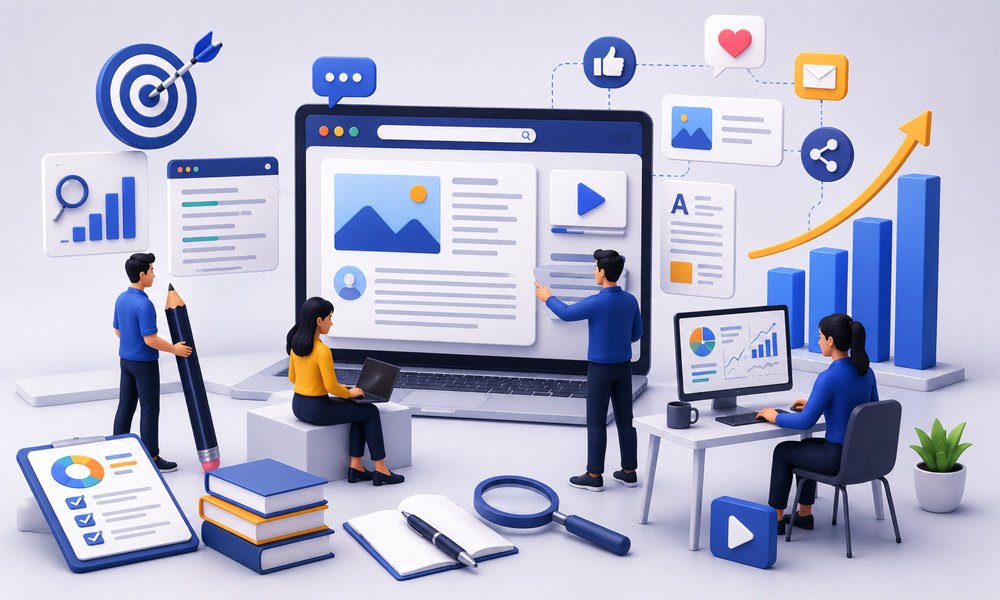
Create Content That Attracts, Educates & Converts
Your customers are searching for information before they make business decisions.
They may search Google for answers, read industry articles, compare solutions, follow companies on LinkedIn, watch videos, download guides, or explore service pages before they ever contact a sales team.
This makes content an important part of the modern customer journey.
At HexaLearn, our content marketing services help businesses create strategic, valuable, and audience-focused content that improves brand visibility, builds authority, attracts relevant traffic, supports SEO, generates leads, and contributes to long-term business growth.
We combine content strategy, keyword research, SEO content, website content, blogs, landing pages, thought leadership, social media content, case studies, and other content formats to create a connected content ecosystem.
Our goal is not to produce content simply for the sake of publishing.
We create content with a purpose.
Every piece should answer a customer question, solve a problem, demonstrate expertise, support a marketing objective, or move a potential customer closer to a business decision.
Ready to turn content into a growth channel?
What Is Content Marketing?
Content marketing is a strategic approach to creating and distributing useful, relevant, and consistent content to attract and engage a defined audience.
Instead of relying only on promotional messages, content marketing helps businesses educate their audiences and demonstrate expertise.
Content can take many forms, including:
- Blog articles
- Website content
- Service pages
- Landing pages
- Case studies
- Whitepapers
- Industry reports
- Guides
- eBooks
- Infographics
- Videos
- Social media posts
- Email content
- FAQs
- Thought-leadership articles
- Educational resources
The right content mix depends on your audience, industry, business model, sales cycle, and marketing objectives.
A technology company may need technical guides and solution pages.
A B2B service company may benefit from case studies, thought leadership, and educational articles.
An eLearning company may need content around learning technology, instructional design, corporate training, and digital learning.
Our content strategy is customized around these differences.
Why Content Marketing Matters
People do not always become customers after seeing one advertisement or visiting one webpage.
They often need information before they feel confident enough to contact a company.
Content helps fill that information gap.
A strong content marketing strategy can help your business:
- Increase brand awareness
- Attract organic traffic
- Educate potential customers
- Demonstrate expertise
- Build trust
- Support SEO
- Generate leads
- Improve website engagement
- Support sales teams
- Strengthen customer relationships
- Build long-term authority
Content can also continue generating value after it is published.
A useful article can attract organic traffic for months or years.
A case study can support multiple sales conversations.
A research report can generate backlinks and media attention.
A LinkedIn article can become multiple social posts.
This makes content one of the most reusable assets within a digital marketing strategy.
Our Content Marketing Services
1. Content Marketing Strategy
Successful content marketing starts with strategy.
Before creating content, we identify your audience, business objectives, market, competitors, topics, keywords, customer journey, and conversion goals.
Our content strategy can include:
- Audience research
- Buyer persona analysis
- Competitor research
- Content audits
- Keyword research
- Search-intent analysis
- Topic research
- Content pillars
- Content calendars
- Content distribution
- Conversion strategy
- Performance measurement
The result is a structured content roadmap that defines what content should be created, why it should be created, who it is for, and how it contributes to your business goals.
2. SEO Content Marketing
Content and SEO work closely together.
Search engines need useful, relevant content to understand what your website offers and determine which pages may be valuable for particular searches.
Our SEO content strategy combines:
- Keyword research
- Search intent
- Topic research
- Content structure
- On-page SEO
- Internal linking
- Content optimization
- Content freshness
- Search performance analysis
We do not recommend creating content simply by inserting keywords repeatedly.
Instead, we focus on covering the topic comprehensively and naturally while answering the questions your audience is actually asking.
Our SEO services can work alongside content marketing to create stronger organic search opportunities.
3. Blog Content Writing
A business blog can become a valuable source of organic traffic, expertise, and customer education.
However, publishing articles without a clear strategy can make it difficult to generate meaningful results.
Our blog content strategy focuses on topics that have relevance to your audience and business.
Blog content can include:
- How-to articles
- Educational guides
- Industry trends
- Expert insights
- Best practices
- Problem-solving articles
- Technology explainers
- Comparison articles
- Frequently asked questions
- Industry analysis
We structure articles around user intent and create logical opportunities for readers to move from educational content to relevant service pages.
4. Website Content
Your website content communicates your value to potential customers.
It should explain what you offer, who you serve, how your solutions work, and why customers should consider your business.
We can develop and optimize:
- Homepage content
- Service pages
- Product pages
- Industry pages
- Location pages
- About pages
- Landing pages
- FAQ sections
- Resource pages
Website content should balance SEO requirements with user experience.
A page should be easy to understand, useful to visitors, and structured around a clear purpose.
5. Landing Page Content
Landing pages are designed to guide visitors toward a specific action.
They may be used for:
- Lead generation
- Service promotion
- Paid advertising
- SEO campaigns
- Product launches
- Webinar registration
- Content downloads
- Consultation requests
Effective landing-page content should communicate the value proposition quickly and provide enough information to help visitors make a decision.
We can structure landing-page content around:
Problem → Solution → Benefits → Evidence → Differentiators → Call to Action
This approach helps create a clear path from visitor interest to conversion.
6. B2B Content Marketing
B2B buyers often conduct extensive research before making purchasing decisions.
They may compare vendors, evaluate technologies, research pricing, examine capabilities, and look for evidence of expertise.
Our B2B content marketing strategy can include:
- Industry articles
- Thought leadership
- Case studies
- Whitepapers
- Research reports
- Solution guides
- Service pages
- Comparison content
- Expert articles
- LinkedIn content
Content can support different stages of the B2B buying journey.
Awareness
Help potential customers understand a challenge.
Consideration
Explain possible approaches and solutions.
Evaluation
Help prospects compare options.
Decision
Provide evidence, expertise, and reasons to choose your organization.
Retention
Continue educating customers after conversion.
7. Thought Leadership Content
Thought leadership helps organizations demonstrate knowledge and perspective within their industry.
Instead of simply promoting products and services, thought-leadership content addresses important industry questions and provides informed perspectives.
Examples include:
- Industry trends
- Expert opinions
- Market analysis
- Predictions
- Research insights
- Emerging technologies
- Industry challenges
- Business lessons
- Strategic recommendations
Authentic thought leadership should come from real knowledge and experience.
It should provide something useful to the reader rather than simply repeating information already available elsewhere.
8. Case Study Content
Case studies provide evidence that your organization can deliver results.
A strong case study can explain:
Challenge → Approach → Solution → Implementation → Outcome
Case studies can help potential customers understand:
- The problem you solved
- Your methodology
- Your expertise
- Your technology
- Your process
- The value you delivered
They can also be reused across multiple channels, including your website, sales presentations, LinkedIn, email campaigns, and proposals.
9. eLearning & EdTech Content Marketing
HexaLearn's experience in the eLearning industry allows us to create content for organizations operating in learning technology and corporate training.
We can develop content around:
- eLearning
- Corporate training
- Instructional design
- LMS technology
- Microlearning
- mobile learning
- Learning analytics
- AI in eLearning
- Digital learning
- Training technology
- Employee development
For organizations offering custom eLearning development, content marketing can help attract decision-makers searching for learning solutions.
Educational content can answer common customer questions while service pages provide a path toward conversion.
10. Technology Content Marketing
Technology products and services can sometimes be difficult to explain to non-technical audiences.
Content marketing can translate complex technology into understandable business value.
We can develop:
- Technology explainers
- Product guides
- Solution articles
- Use cases
- Implementation guides
- Industry insights
- Technical blogs
- Comparison content
- FAQs
The objective is to explain not only what a technology does, but why it matters to the customer.
11. Social Media Content
Content marketing does not end when an article is published.
Social media can extend the reach of your content and create additional opportunities for audience engagement.
A single article can be repurposed into:
- LinkedIn posts
- Social media carousels
- Infographics
- Short videos
- Quotes
- Questions
- Polls
- Industry insights
Our social media marketing services can help distribute content and maintain consistent communication across relevant platforms.
12. Email Content Marketing
Email provides a direct communication channel with prospects and customers.
Content can be used to educate subscribers, nurture leads, share industry insights, and promote useful resources.
Email content can include:
- Newsletters
- Educational emails
- Industry updates
- New articles
- Research reports
- Guides
- Product information
- Service updates
- Event invitations
Effective email content should provide value and be relevant to the recipient.
13. Content Repurposing
Creating high-quality content requires time and resources.
Content repurposing helps businesses extend the value of existing content.
For example, one comprehensive article can become:
1 Blog Article
→ 3 LinkedIn Posts
→ 1 Infographic
→ 1 Carousel
→ 1 Email
→ 1 Short Video
→ Multiple Social Media Updates
This approach helps maintain consistency while reducing the need to create completely new content for every channel.
14. Content Distribution Strategy
Creating great content is only half the process.
The content also needs to reach the right audience.
Distribution channels can include:
- Organic search
- Social media
- Online communities
- Industry publications
- Guest contributions
- Digital PR
- Partner websites
We identify distribution channels based on your audience and content type.
The objective is to maximize the useful reach of every important piece of content.
15. Content Audit & Optimization
Existing content can represent a significant SEO and marketing opportunity.
Instead of creating new content continuously, businesses can often improve existing pages.
Our content audit can identify:
- Outdated information
- Low-performing articles
- Duplicate topics
- Keyword gaps
- Content cannibalization
- Missing internal links
- Weak calls to action
- Thin content
- Poor search intent alignment
- Opportunities for content consolidation
We then prioritize pages based on their potential business and search value.
16. Content Gap Analysis
A content gap exists when your audience is searching for information that your website does not adequately address.
We analyze:
- Competitor content
- Keyword opportunities
- Search intent
- Customer questions
- Existing website content
- Industry topics
This helps identify subjects that should be added to your content strategy.
Content gap analysis can also reveal opportunities to create supporting articles around important commercial service pages.
Our Content Marketing Process
Step 1: Business Discovery
We understand your products, services, target market, audience, competitors, and objectives.
Step 2: Audience Research
We identify the questions, challenges, needs, and interests of your target audience.
Step 3: Content Audit
We review existing content to identify strengths, weaknesses, gaps, and opportunities.
Step 4: Keyword Research
We identify relevant search terms and organize them according to search intent and business value.
Step 5: Content Strategy
We create content pillars, topics, formats, priorities, and publishing schedules.
Step 6: Content Creation
Content is developed according to the strategy and optimized for the intended audience and channel.
Step 7: SEO Optimization
Relevant content is optimized for search intent, keywords, headings, internal links, metadata, and other on-page elements.
Step 8: Publishing & Distribution
Content is published and distributed through appropriate digital channels.
Step 9: Performance Monitoring
We track traffic, rankings, engagement, conversions, and other relevant metrics.
Step 10: Continuous Optimization
Content is updated, expanded, repurposed, or improved based on performance and changing audience needs.
Content Marketing Funnel
Content should support the complete customer journey.
Top of Funnel: Awareness
Attract people who are discovering a problem or researching a topic.
Content examples:
- Blog articles
- Educational guides
- Industry trends
- Social posts
- Videos
Middle of Funnel: Consideration
Help potential customers evaluate possible solutions.
Content examples:
- Comparison articles
- Case studies
- Whitepapers
- Webinars
- Solution guides
Bottom of Funnel: Decision
Help prospects choose a provider.
Content examples:
- Service pages
- Product pages
- Testimonials
- Case studies
- Consultation pages
- Demonstrations
Post-Purchase
Continue providing value through:
- Educational content
- Customer resources
- Updates
- Newsletters
- Best practices
Content Marketing + SEO
Content marketing and SEO should work together.
SEO identifies what people search for.
Content provides useful answers.
Internal linking connects related information.
Landing pages provide commercial destinations.
Analytics measures performance.
Together, these elements can create a sustainable organic growth system.
For example:
Keyword Research → Content → SEO Optimization → Internal Linking → Organic Traffic → Service Page → Lead
This is why content should be planned as part of the wider digital marketing strategy rather than as an isolated activity.
Content Marketing + Social Media
Social media gives content another distribution channel.
An article published on your website can be transformed into multiple social media assets.
This creates a connection between:
Website Content → Social Media → Audience Engagement → Website Traffic → Conversion
Our social media strategy can therefore complement your content marketing activities and help increase the useful reach of your content.
Content Marketing for B2B Businesses in India
B2B businesses in India operate in competitive markets where potential customers often research vendors online before making contact.
Content marketing can help businesses build visibility among decision-makers by addressing their questions and demonstrating expertise.
Our B2B digital marketing can integrate content with SEO, LinkedIn marketing, lead generation, website optimization, and other digital channels.
Content strategies can target:
- Indian businesses
- International buyers
- Technology companies
- eLearning organizations
- Professional services
- SaaS companies
- Enterprise solutions
- Training providers
Content Marketing for International Markets
Businesses targeting international customers need content that reflects the needs and terminology of their target markets.
International content marketing may require:
- Market-specific keyword research
- Local search intent
- Regional terminology
- Audience segmentation
- Competitor research
- Localized content
- International SEO
We can help businesses develop content strategies for audiences in India and international markets.
Why Choose HexaLearn for Content Marketing?
eLearning & Technology Experience
HexaLearn has extensive experience in eLearning, digital learning, software, and technology solutions. This helps us understand technical and B2B subjects that require specialized content.
Integrated Digital Marketing
Content performs better when it works together with SEO, social media, websites, lead generation, and other marketing channels.
Our broader digital marketing capabilities allow us to create connected strategies.
Audience-Focused Content
We focus on what your audience needs to know rather than simply filling a publishing calendar.
SEO-Aware Content
Our content strategy considers search intent, keywords, internal linking, website structure, and organic search opportunities.
Business-Focused Approach
Content should contribute to a business objective.
That objective may be visibility, traffic, authority, engagement, lead generation, or sales support.
Long-Term Content Assets
We create content that can continue generating value through organic search, social distribution, email, sales enablement, and customer education.
Common Content Marketing Challenges We Solve
"We Don't Know What Content to Create"
We research your audience, competitors, keywords, industry, and business goals to develop a structured content roadmap.
"Our Blog Gets Very Little Traffic"
We analyze search intent, keyword targeting, content quality, competition, technical factors, and internal linking to identify opportunities.
"We Publish Regularly but Don't Generate Leads"
We review whether content is connected to commercial pages, calls to action, conversion paths, and relevant search intent.
"Our Content Is Not Ranking"
We examine content depth, search intent, keyword targeting, technical SEO, internal links, and authority.
"We Have Too Many Similar Articles"
We can identify overlapping topics and recommend consolidation, optimization, redirection, or clearer keyword mapping.
"Our Content Becomes Outdated Quickly"
We can create a content-refresh strategy that identifies pages requiring updates based on changing information, search trends, and performance.
Content Marketing Metrics That Matter
Content marketing should be measured according to its objectives.
Visibility
- Organic impressions
- Search rankings
- Brand visibility
- Content reach
Traffic
- Organic traffic
- Referral traffic
- Social traffic
- Landing-page visits
Engagement
- Time on page
- Scroll depth
- Social engagement
- Returning visitors
Lead Generation
- Form submissions
- Consultation requests
- Content downloads
- Qualified leads
Business Impact
- Marketing-qualified leads
- Sales opportunities
- Assisted conversions
- Customer acquisition
The right KPI framework depends on your business model and objectives.
Frequently Asked Questions About Content Marketing
What are content marketing services?
Content marketing services involve planning, creating, optimizing, publishing, distributing, and measuring content designed to attract and engage a specific audience and support business objectives.
Why is content marketing important for SEO?
Search engines rely on relevant and useful content to understand topics and provide results to users. A strategic content program can create opportunities to rank for relevant searches and attract organic traffic.
What types of content do you create?
We can support blogs, service pages, landing pages, case studies, guides, whitepapers, thought leadership, FAQs, social media content, email content, and other formats based on your objectives.
Can content marketing generate leads?
Yes. Content can attract relevant audiences and guide them toward service pages, landing pages, lead magnets, consultation forms, and other conversion opportunities.
How often should a business publish content?
There is no universal publishing frequency. Quality, relevance, consistency, and strategic value are more important than publishing a specific number of articles.
Do you provide SEO content writing?
Yes. Content can be developed and optimized around relevant keywords, search intent, audience needs, internal linking, and business objectives.
Do you provide B2B content marketing?
Yes. We can develop B2B content strategies for technology companies, eLearning businesses, professional services organizations, software companies, and other B2B businesses.
Can you update our existing content?
Yes. Content audits can identify outdated, underperforming, overlapping, or incomplete content that may benefit from optimization or expansion.
Do you provide content marketing services in India?
Yes. HexaLearn provides content marketing services for businesses targeting Indian and international audiences.
How do you measure content marketing success?
We can measure organic visibility, traffic, engagement, rankings, leads, conversions, content downloads, and business-focused metrics depending on the campaign objectives.
Turn Content Into a Long-Term Business Asset
Content should do more than fill your website or social media calendar.
It should help your business become more visible, demonstrate expertise, answer customer questions, build trust, support SEO, and create opportunities for conversion.
At HexaLearn, our content marketing services combine strategy, research, SEO, content creation, distribution, and performance analysis to help businesses create content that supports measurable growth.
Whether you need a content strategy, SEO blog content, website copy, landing pages, B2B content, thought leadership, eLearning content, case studies, or content optimization, we can help you create a structured content program around your business goals.
Ready to Build a Stronger Content Strategy?
Tell us about your business, audience, industry, existing content, and marketing objectives.
Our team can identify content opportunities and develop a practical strategy to improve visibility, engagement, authority, and lead generation.
Schedule a demo with our eLearning experts.