

Corporate Video Production Services for Training, Communication & Business Growth
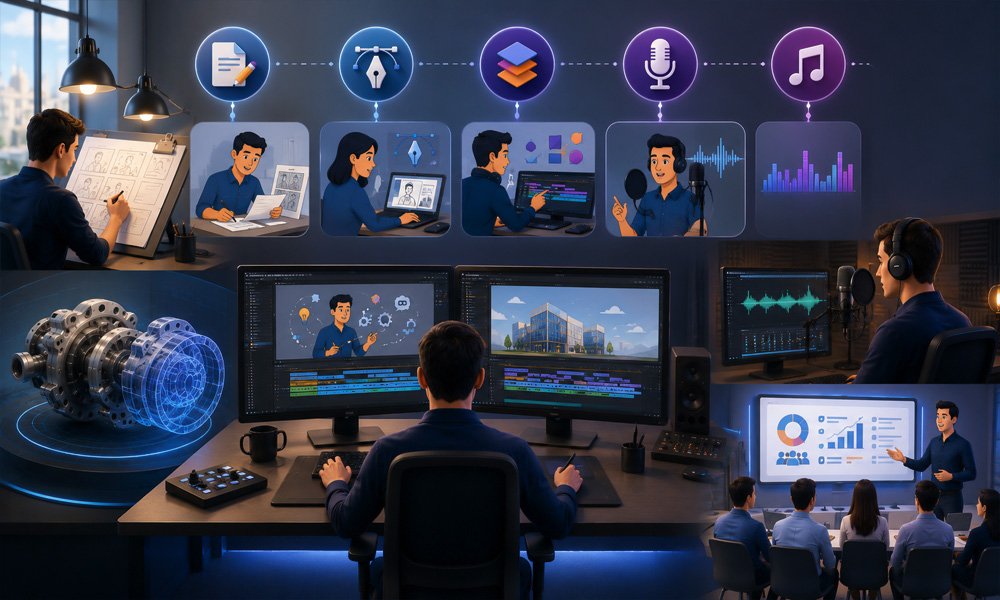
Modern businesses use video for far more than company introductions.
A corporate video can help a company explain its products, introduce its brand, train employees, communicate internal changes, demonstrate a process, showcase its workplace, support recruitment, or tell a customer's story.
That makes corporate video production a broad business communication service rather than a single type of video.
At HexaLearn, we create professional corporate videos for organizations that need to communicate clearly with employees, customers, prospects, partners, learners, and other stakeholders.
Our production approach can combine video, animation, motion graphics, screen recordings, 2D animation, 3D visualization, voiceover, music and sound design depending on the objective.
The right production style depends on what you need the audience to understand.
A company profile may benefit from interviews and workplace footage.
A product video may require screen recording or 3D visualization.
An employee training video may need demonstrations, narration, graphics, and assessments.
An internal communication video may simply require a clear message from leadership supported by professional editing and branding.
Corporate video therefore starts with a question:
What does the audience need to know, understand, feel, or do after watching the video?
That question guides the concept, script, visual treatment, production, and final delivery.
Looking for corporate video production for your organization? Let's discuss your requirements.
Corporate video has applications across marketing, sales, training, recruitment, internal communication, customer education, and stakeholder communication.
What Is Corporate Video Production?
Corporate video production is the process of planning, creating, recording, editing, and delivering video content for a business or organization.
The term covers a wide range of formats.
For example, an organization may need:
- Company profile videos
- Brand story videos
- Product demonstration videos
- Training videos
- Employee onboarding videos
- Internal communication videos
- Recruitment videos
- Customer testimonial videos
- Corporate event videos
- Executive messages
- Sales presentation videos
- Technical demonstration videos
- Process videos
- Educational videos
- Social media corporate videos
Each format has a different purpose, audience, tone, and production requirement.
A recruitment video is designed to attract potential employees.
A training video is designed to help employees learn.
A product video is designed to help customers understand an offering.
An executive communication video is designed to deliver an important organizational message.
Therefore, effective corporate video production begins with purpose and audience, not cameras or animation.
Why Do Businesses Need Corporate Videos?
Businesses communicate with multiple audiences every day.
Employees need information.
Customers need product knowledge.
Prospects need to understand services.
New hires need onboarding.
Sales teams need presentation material.
Leadership teams need to communicate strategic initiatives.
Marketing teams need brand content.
Video can provide a consistent visual communication format across these different requirements.
Corporate video can be particularly useful when the subject involves:
- Complex information
- Demonstrations
- Human stories
- Processes
- Products
- Workplace environments
- Technical concepts
- Training
- Organizational changes
Instead of asking an audience to interpret several pages of information, video can combine narration, visuals, demonstrations, graphics, and examples into one structured experience.
For corporate communication, the value of video comes from matching the format to the objective. Current corporate video practices span internal communication, training, marketing, recruitment, customer content, and sales enablement.
Our Corporate Video Production Services
HexaLearn develops corporate video content for different business and organizational requirements.
1. Corporate Brand Videos
A corporate brand video introduces an organization and communicates its identity.
It can showcase:
- Company vision
- Mission
- Values
- People
- Workplace
- Capabilities
- Products
- Services
- Culture
- Customer focus
Rather than simply listing services, the video can tell the story of what the organization does and why it matters.
A brand video can be used on:
- Corporate websites
- Company presentations
- Conferences
- Sales meetings
- Social media
- Events
- Investor communication
- Recruitment campaigns
The visual approach can combine interviews, workplace footage, product shots, motion graphics, animation, customer stories, and professional narration.
2. Company Profile Videos
A company profile video provides a concise overview of an organization.
It may answer:
Who are you?
What do you do?
Who do you serve?
What capabilities do you have?
What makes your organization different?
A company profile video can be particularly useful when an organization needs a standardized introduction for prospective customers, partners, employees, or event audiences.
Instead of presenting company information as a long document, the video can bring the organization, people, products, and working environment together.
3. Corporate Training Videos
Training is one of the most practical applications of corporate video.
Organizations can create video-based training for:
- Employee onboarding
- Product knowledge
- Process training
- Compliance
- Safety
- Customer service
- Workplace policies
- Technical training
- Software training
- Soft skills
- Leadership development
Training videos can combine demonstrations, screen recordings, animation, interviews, scenarios, narration, graphics, and on-screen text.
For organizations building a larger digital learning program, corporate videos can also be integrated into custom eLearning development
This allows a video to become part of a broader learning experience rather than functioning only as a standalone asset.
4. Employee Onboarding Videos
The first days and weeks of an employee's journey often involve a significant amount of information.
A series of onboarding videos can introduce:
- Company history
- Organizational culture
- Leadership
- Policies
- Work processes
- Technology
- Products
- Teams
- Workplace practices
- Employee responsibilities
Instead of delivering all information through live sessions, organizations can create reusable onboarding content that employees can access when needed.
An onboarding video can also provide a consistent introduction for every new employee.
5. Internal Communication Videos
Internal communication does not always need to be delivered through emails or lengthy documents.
Video can help organizations communicate:
- Leadership messages
- Organizational updates
- Business changes
- New initiatives
- Policy changes
- Company milestones
- Culture initiatives
- Strategic priorities
- Employee announcements
For example, a leadership team can communicate an organizational change through a short executive video supported by relevant graphics.
This can make the message more personal and provide employees with both verbal and visual context.
Internal communication is now considered one of the established corporate video applications alongside training, marketing, recruitment, and stakeholder communication.
6. Product Demonstration Videos
A product may have numerous features that are difficult to explain through text alone.
A corporate product video can demonstrate:
- Product features
- Product benefits
- Product operation
- User workflows
- Key functions
- Use cases
- Product advantages
- Customer applications
For physical products, production can include product photography, live-action demonstrations, 3D animation, or product visualization.
For software products, screen recording and motion graphics can demonstrate actual workflows.
For technical products, animation can explain internal mechanisms or processes.
7. Corporate Explainer Videos
Some business concepts require more explanation than a standard promotional video can provide.
A corporate explainer video can simplify:
- Business services
- Processes
- Technology
- Products
- Systems
- Solutions
- Customer journeys
- Technical concepts
Animation and motion graphics can be particularly useful when the subject cannot easily be captured through live-action footage.
For projects where the primary goal is explaining a product, process, or concept, you can also explore HexaLearn's explainer video production services.
This gives the explainer page a distinct role while this corporate video page remains focused on broader organizational communication.
8. Corporate Recruitment Videos
Recruitment videos can show potential employees what it is like to work for an organization.
Instead of relying only on written job descriptions, a recruitment video can showcase:
- Workplace
- Employees
- Leadership
- Company culture
- Employee experiences
- Career opportunities
- Work environment
- Values
- Team activities
Employee interviews and authentic workplace footage can help communicate the organization from the perspective of its people.
Recruitment and employer-branding content are established corporate video formats used to support hiring.
9. Employee Testimonial Videos
Employees can provide a human perspective on an organization.
A testimonial video can feature employees discussing:
- Their role
- Career journey
- Workplace experience
- Team culture
- Learning opportunities
- Projects
- Company environment
The content should feel authentic rather than overly scripted.
A series of short employee testimonials can also be used across recruitment campaigns, careers pages, social media, and corporate presentations.
10. Customer Testimonial Videos
Customer stories can demonstrate how a product or service has been used in the real world.
A customer testimonial video can cover:
Customer Challenge → Solution → Implementation → Experience → Outcome
Depending on the project, it may include:
- Customer interviews
- Product demonstrations
- Before-and-after context
- Supporting footage
- Data or graphics
- Narration
- Company branding
Customer stories can be particularly useful for sales enablement because they provide context around the customer's experience rather than simply presenting a list of product features.
11. Corporate Event Videos
Organizations frequently participate in or host:
- Conferences
- Seminars
- Workshops
- Exhibitions
- Product launches
- Annual meetings
- Employee events
- Award ceremonies
- Corporate celebrations
Event video production can capture:
- Key moments
- Speaker presentations
- Audience interactions
- Interviews
- Product demonstrations
- Networking
- Highlights
- Behind-the-scenes footage
The final video can be edited as a short event highlight, longer recap, social media clips, or an internal communication asset.
12. Leadership and Executive Videos
Leadership communication can be used for both internal and external audiences.
Examples include:
- CEO messages
- Founder interviews
- Executive announcements
- Leadership interviews
- Strategic updates
- Company milestone videos
- Thought leadership
The production style can be formal or conversational depending on the message and audience.
A professional setup can include appropriate lighting, framing, audio, branded backgrounds, supporting graphics.
13. Sales Enablement Videos
Sales teams often need to explain the same products and services repeatedly.
Corporate video can provide reusable sales content.
Examples include:
- Product demonstrations
- Service overviews
- Customer case studies
- Solution explainers
- Executive presentations
- Product comparisons
- Technical demonstrations
- Proposal videos
A sales team can use these videos during presentations, meetings, email outreach, proposals, and follow-up communication.
14. Corporate Social Media Videos
Corporate video content can also be adapted for digital channels.
Examples include:
- Company announcements
- Leadership clips
- Event highlights
- Product launches
- Employee stories
- Customer testimonials
- Behind-the-scenes content
- Educational clips
- Industry insights
Instead of creating a single long video, a larger production can sometimes be structured so that multiple short clips can be created from the same source material.
This can increase the number of usable assets from one production project.
15. Technical Corporate Videos
Technical subjects often require a different production approach.
A technical corporate video may explain:
- Equipment
- Machinery
- Software
- Engineering systems
- Manufacturing processes
- Technical products
- Industrial operations
- Product architecture
Live-action footage can be combined with animation and graphics.
For example, footage of a machine could be supplemented with animated overlays showing individual components.
A 3D model could then demonstrate an internal mechanism.
For projects requiring detailed three-dimensional product or technical visualization, HexaLearn's 3D animation services in India can complement corporate video production.
16. Corporate Safety Videos
Safety communication requires clarity.
A safety video can demonstrate:
- Correct procedures
- Workplace hazards
- Personal protective equipment
- Emergency procedures
- Equipment handling
- Workplace behavior
- Safety protocols
Rather than simply listing safety rules, video can show realistic situations and demonstrate what employees should do.
For technical environments, animation can also recreate situations that may be difficult or unsafe to film directly.
17. Corporate Process Videos
Businesses often have processes that employees, customers, or partners need to understand.
A process video can visualize:
Step 1 → Step 2 → Step 3 → Step 4 → Final Outcome
Examples include:
- Manufacturing
- Customer onboarding
- Service delivery
- Logistics
- Software workflows
- Quality control
- Internal processes
- Operational procedures
Process videos can also be used as training resources.
18. Corporate Presentation Videos
Presentations can benefit from video when information needs to be demonstrated rather than simply described.
A corporate presentation video can combine:
- Presenter footage
- Voiceover
- Slides
- Motion graphics
- Animation
- Product demonstrations
- Screen recordings
- Data visualization
This approach can create a more dynamic presentation while maintaining corporate professionalism.
Live-Action vs. Animated Corporate Videos
Corporate video does not necessarily mean filming people in an office.
Different subjects require different production formats.
Live-Action Video
Best suited for:
- Company profiles
- Interviews
- Testimonials
- Events
- Workplace culture
- Leadership communication
- Product demonstrations
2D Animation
Best suited for:
- Abstract concepts
- Training
- Business processes
- Educational content
- Corporate explainers
- Character scenarios
- Motion graphics
Explore 2D animation services in India when the communication objective is better served by illustrated storytelling.
3D Animation
Best suited for:
- Physical products
- Technical systems
- Machinery
- Engineering
- Medical devices
- Internal components
- Product visualization
Hybrid Video
Combines multiple approaches.
For example:
Live-Action Interview + 2D Graphics + Screen Recording + 3D Visualization
A hybrid approach can be useful when one format alone cannot communicate the entire subject effectively.
Our Corporate Video Production Process
Professional corporate video production requires more than recording and editing.
The process should connect the business objective, audience, message, visuals, production style, and distribution channel.
Step 1: Project Discovery
We begin by understanding the project.
Key questions include:
- What is the purpose of the video?
- Who will watch it?
- Where will it be published?
- What action should viewers take?
- What information must be communicated?
- What source content already exists?
- Is live-action required?
- Is animation required?
- What is the expected duration?
- What is the delivery timeline?
This stage helps establish the production requirements before creative development begins.
Step 2: Audience and Communication Strategy
A corporate video should be created around the audience.
For example:
Employees may need practical information.
Customers may need product benefits.
Prospects may need evidence and differentiation.
Candidates may need to understand company culture.
Leadership may need concise strategic communication.
The same company may therefore require several different video formats.
Step 3: Concept Development
The creative concept determines how the message will be presented.
It may involve:
- Interviews
- Narration
- Demonstration
- Animation
- Storytelling
- Customer case study
- Product visualization
- Workplace footage
The concept should match both the audience and the objective.
Step 4: Scriptwriting
The script defines the message.
A corporate video script can include:
- Introduction
- Context
- Key message
- Supporting information
- Demonstration
- Customer or employee story
- Benefits
- Conclusion
- Call to action
The writing style should reflect the organization and audience.
Step 5: Storyboarding
For animation-heavy or highly structured projects, storyboarding provides a visual plan before production.
A storyboard can specify:
- Scene
- Camera
- Visual
- Narration
- On-screen text
- Animation
- Transition
- Audio
This is particularly important when live-action and animation need to work together.
For projects involving structured learning content, our storyboarding services can support the planning stage.
Step 6: Pre-Production
For live-action projects, pre-production may include:
- Location planning
- Interview planning
- Shot lists
- Talent coordination
- Equipment
- Lighting
- Audio
- Props
- Production schedule
- Brand requirements
Good preparation can reduce production problems during filming.
Step 7: Video Production
The production stage may involve:
- Interviews
- Presentations
- Product demonstrations
- Workplace footage
- Event coverage
- Employee testimonials
- B-roll
- Screen recordings
- Product footage
The production setup depends on the type of video.
Step 8: Animation and Motion Graphics
Animation can be introduced wherever live-action footage needs additional explanation.
Examples include:
- Animated titles
- Lower thirds
- Infographics
- Charts
- Process diagrams
- Product visualization
- Technical overlays
- 2D animation
- 3D animation
This allows the video to communicate information that may not be visible through the camera alone.
Step 9: Voiceover and Audio
Audio has a major role in professional corporate videos.
Depending on the project, we can incorporate:
- Professional voiceover
- Interview audio
- Background music
- Sound effects
- Ambient sound
- Audio transitions
Voiceover should be synchronized with the visuals and should match the tone of the communication.
Step 10: Video Editing
Editing brings the production together.
The editor determines:
- Scene order
- Timing
- Transitions
- Pacing
- Graphics
- Music
- Voiceover
- Supporting footage
- Animation integration
The objective is to create a coherent viewing experience.
Step 11: Review and Quality Assurance
The completed video is reviewed for:
- Message accuracy
- Brand consistency
- Visual quality
- Audio quality
- Voiceover synchronization
- Text accuracy
- Animation timing
- Technical specifications
- Overall flow
Feedback is incorporated according to the agreed review process.
Step 12: Final Delivery
Corporate videos can be prepared for:
- Websites
- YouTube
- LMS platforms
- Internal portals
- Presentations
- Events
- Sales meetings
- Social media
- Mobile viewing
Different platforms may require different aspect ratios, resolutions, captions, or versions.
Corporate Video Production for eLearning
Corporate video and eLearning can work together particularly well.
A training program may combine:
Corporate Video → Interactive Learning → Practice → Assessment → Feedback
For example, a company could use a professionally filmed executive video to introduce a new initiative, followed by animated learning content explaining the process and an interactive assessment checking employee understanding.
Video can also demonstrate:
- Equipment
- Workplace procedures
- Software
- Customer interactions
- Safety procedures
- Technical processes
For organizations developing complete digital learning programs, corporate video can become one component of a larger eLearning content development strategy.
This is especially useful when the organization needs a combination of video, animation, interactions, assessments, and learning content rather than a standalone corporate film.
Corporate Video for Employee Training
Training videos can be developed for both short and extended learning programs.
Onboarding
Introduce the company, teams, products, culture, and workplace processes.
Compliance
Explain rules, policies, responsibilities, and required procedures.
Safety
Demonstrate correct workplace practices and potential hazards.
Product Training
Teach employees about products, features, applications, and customer questions.
Technical Training
Demonstrate systems, equipment, processes, and procedures.
Soft Skills
Use scenarios and role-play to demonstrate communication, customer service, leadership, or workplace behavior.
For more complex subjects, video can be combined with animation and interactive learning activities.
Corporate Video for Internal Communication
Internal communication videos can be short and focused.
For example, a 90-second leadership message might communicate:
- What has changed
- Why it changed
- What employees need to know
- What happens next
Other videos may cover company milestones, organizational updates, employee initiatives, or new business strategies.
The appropriate length depends on the message.
The goal should be clarity rather than unnecessary duration.
Corporate Video for Marketing and Sales
Marketing and sales teams can use corporate videos throughout the customer journey.
Awareness
Company and brand videos.
Consideration
Product explainers and demonstrations.
Evaluation
Customer testimonials and case studies.
Decision
Detailed product or service presentations.
Onboarding
Customer education videos.
This creates opportunities to reuse video content across multiple stages rather than treating each production as an isolated asset.
Industries We Serve
Corporate video production can be adapted to different industries.
Technology and SaaS
Product demonstrations, software walkthroughs, corporate communication, onboarding, and sales videos.
Manufacturing
Equipment demonstrations, production processes, safety, employee training, and company profiles.
Healthcare
Medical education, healthcare services, patient communication, device demonstrations, and professional training.
Education
Training programs, educational videos, institutional communication, and learning content.
Engineering
Technical demonstrations, product visualization, process videos, and training.
Automotive
Product demonstrations, technical communication, training, and marketing.
Financial Services
Customer education, corporate communication, service explanations, and internal training.
Logistics
Operational processes, safety, employee training, and service communication.
Energy
Technical communication, safety training, equipment demonstrations, and corporate communication.
Professional Services
Company profiles, service explanations, thought leadership, customer stories, and recruitment.
Benefits of Professional Corporate Video Production
Consistent Communication
A professionally produced video provides a consistent message that can be reused across audiences and channels.
Better Demonstration
Products, processes, and systems can be shown rather than described.
Stronger Human Connection
Interviews and employee stories can bring an organization to life.
Reusable Training Content
Training videos can support repeat learning and onboarding.
Flexible Distribution
The same core production can potentially be adapted into multiple versions and formats.
Better Visualization
Animation and motion graphics can explain information that cannot easily be captured through live footage.
Professional Brand Presentation
Production quality can support the organization's overall brand communication.
How to Make a Corporate Video Effective
Start With the Business Objective
Do not begin with the question:
“What kind of video should we make?”
Start with:
“What does the business need the video to accomplish?”
The answer determines the format.
Keep the Audience at the Center
A video for employees should not be written like an advertisement.
A customer video should focus on customer needs.
A recruitment video should showcase the employee experience.
An executive communication should prioritize clarity and credibility.
Build a Strong Story
Even corporate communication needs structure.
A simple structure might be:
Context → Challenge → Message → Evidence → Action
For a product:
Problem → Product → Demonstration → Benefits → CTA
For training:
Situation → Correct Approach → Demonstration → Practice → Reinforcement
Use Visuals to Explain
Do not use visuals simply because the screen needs something to display.
If the narration says that a process has three stages, show those three stages.
If the narrator describes a product component, show it.
If an executive is discussing a business result, use appropriate graphics to support the information.
Keep the Message Focused
Corporate videos often become overloaded with information.
A better approach is to identify the most important message and build the video around it.
Additional information can be delivered through supporting documents, web pages, learning modules, or follow-up videos.
Common Corporate Video Mistakes
1. Making the Video About the Company Instead of the Audience
A company profile should still answer why the information matters to the viewer.
2. Overloading the Script
Trying to communicate too many messages can weaken the main point.
3. Using Generic Stock Footage Everywhere
Stock footage can have a role, but authentic company footage can make the video more relevant.
4. Ignoring Audio Quality
Poor audio can make professionally filmed footage feel unprofessional.
5. Starting Production Without a Clear Script
Pre-production planning reduces unnecessary revisions.
6. Choosing Animation Without a Reason
Animation should clarify the subject, not simply add visual decoration.
7. Forgetting Distribution
The final format should be planned according to where the video will be viewed.
8. Making Every Video the Same Length
A short internal announcement and a detailed training module have different requirements.
Why Choose HexaLearn for Corporate Video Production?
HexaLearn brings together video production, animation, multimedia, and digital learning capabilities.
This is particularly valuable for organizations that need more than conventional corporate filming.
Customized Video Production
Each project is developed around its audience, message, and business objective.
Animation Integration
2D animation, motion graphics, and 3D visualization can be incorporated when live-action alone is not sufficient.
Training Expertise
Our experience with digital learning allows corporate videos to be developed for training and employee education as well as marketing.
End-to-End Workflow
The production can cover concept development, scriptwriting, storyboarding, production, animation, audio, editing, quality assurance, and delivery.
Multiple Corporate Applications
The same production capability can support marketing, sales, training, recruitment, internal communication, and customer education.
Scalable Multimedia Content
A corporate video project can potentially produce multiple assets, such as a primary video, short social clips, training segments, interview excerpts, and supporting graphics.
What Do You Need to Start a Corporate Video Project?
You can begin with a basic project brief.
Useful information includes:
- Business objective
- Target audience
- Video purpose
- Approximate duration
- Existing script
- Company information
- Product information
- Brand guidelines
- Location requirements
- Interview requirements
- Animation requirements
- Voiceover requirements
- Distribution platforms
- Expected timeline
You do not necessarily need a finished script or storyboard before contacting the production team.
The initial discussion can help define the appropriate production approach.
Frequently Asked Questions About Corporate Video Production
What is corporate video production?
Corporate video production is the creation of professional video content for business and organizational purposes. It can include marketing, training, internal communication, recruitment, product demonstrations, customer education, events, and company communication.
What types of corporate videos do you produce?
Corporate video production can include company profile videos, brand films, training videos, onboarding videos, product demonstrations, recruitment videos, customer testimonials, employee testimonials, internal communication videos, event videos, executive messages, technical videos, and sales enablement videos.
How much does corporate video production cost in India?
There is no single price because production requirements vary significantly. Cost depends on factors such as video duration, number of locations, filming days, crew requirements, equipment, actors or presenters, animation, voiceover, travel, and revisions.
A simple interview video and a multi-location corporate film can have very different production requirements.
How long should a corporate video be?
The appropriate length depends on the purpose, audience, and amount of information. A short internal announcement may require only a few minutes, while a training program may require multiple video modules.
The focus should be on communicating the required information clearly rather than meeting an arbitrary duration.
Can you create corporate training videos?
Yes. Corporate training videos can be developed for onboarding, compliance, safety, product training, technical training, customer service, processes, and other employee learning requirements.
Can corporate videos be used in eLearning?
Yes. Corporate videos can be incorporated into eLearning courses alongside animation, interactions, assessments, simulations, and other digital learning components.
Can you create company profile videos?
Yes. Company profile videos can showcase an organization's history, people, capabilities, culture, products, services, and values.
Can you create recruitment videos?
Yes. Recruitment videos can showcase company culture, employees, workplace environments, leadership, career opportunities, and employee experiences.
Can you create product demonstration videos?
Yes. Product demonstrations can use live-action, screen recordings, animation, 3D visualization, or a combination of formats depending on the product.
Can you create videos for internal communication?
Yes. Internal communication videos can support leadership announcements, organizational changes, strategic initiatives, employee communication, and company updates.
Can you include animation in a corporate video?
Yes. Animation can be used for titles, infographics, process explanations, motion graphics, product visualization, technical demonstrations, and other areas where additional visual explanation is useful.
Can you create 2D animated corporate videos?
Yes. 2D animation can be used for corporate explainers, training, process communication, employee scenarios, and business concepts.
Can you create 3D corporate videos?
Yes. 3D animation can be used when the project requires product visualization, technical demonstrations, machinery, engineering systems, medical devices, or internal component visualization.
Can you create customer testimonial videos?
Yes. Customer testimonial videos can combine interviews, product footage, supporting visuals, graphics, and storytelling.
Can you create employee testimonial videos?
Yes. Employee testimonials can be developed for recruitment, employer branding, company culture, and internal communication.
Do you provide scriptwriting?
Script development can be included depending on the project scope and requirements.
Do you provide storyboarding?
Yes. Storyboarding can be included when the project requires detailed visual planning, particularly for animation-heavy or structured corporate videos.
Can you use our existing corporate footage?
Existing footage can be reviewed and incorporated when it meets the project's technical and visual requirements.
Can you create multiple versions of the same corporate video?
Yes. A core video can potentially be adapted into shorter versions, social media clips, training segments, or platform-specific versions depending on the project.
Can corporate videos be produced for different languages?
Yes. Multilingual versions can be planned depending on the narration, on-screen text, localization, and distribution requirements.
Build Corporate Videos That Communicate With Purpose
Corporate video should not simply be about creating polished footage.
It should help your organization communicate something important.
That could be your company's story.
It could be a new product.
It could be an internal change.
It could be a training requirement.
It could be a customer success story.
It could be a complex process that employees need to understand.
It could be a recruitment message designed to introduce your workplace to future employees.
The production approach should change according to the objective.
At HexaLearn, we combine corporate video production, animation, multimedia, visual storytelling, and learning expertise to develop video experiences for business communication and training.
From the initial concept to the final delivery, our process can cover:
Discovery → Concept → Script → Storyboard → Pre-Production → Production → Animation → Editing → Audio → QA → Delivery
Whether you need a company profile video, corporate training video, product demonstration, recruitment video, internal communication video, customer testimonial, technical video, or animated corporate communication, we can help you develop the right format for your audience.
Ready to Create Your Corporate Video?
Schedule a demo with our eLearning experts.