

LMS Development Company for Custom Learning Management Platforms
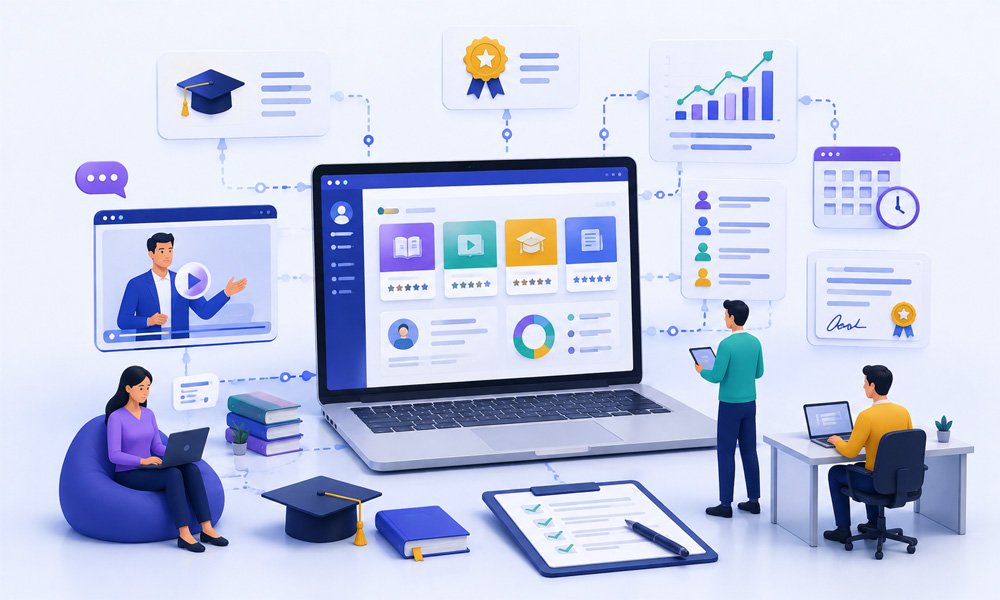
Build an LMS Around Your Learning Model, Users, and Business Requirements
A Learning Management System should do more than host courses.
It should help organizations manage learners, structure programs, assign training, deliver assessments, track progress, organize administrators, generate reports, integrate with other systems, and support the way learning actually operates across the business.
HexaLearn provides custom LMS development services for organizations that need learning platforms designed around their own users, workflows, programs, reporting requirements, and technology environments.
Rather than beginning with a predefined platform structure, we start by understanding how learning is managed within the organization.
Who are the learners? Are they employees, customers, partners, students, distributors, or multiple audiences? How are courses assigned? Do users enroll themselves or receive required training? Are there departments, business units, locations, or customer organizations that need separate administration? What assessments are required? What information should managers see? What reports are needed? Which existing systems need to connect with the LMS?
These requirements shape the platform architecture.
A custom LMS may include learner management, course catalogs, assignments, assessments, certifications, dashboards, reporting, notifications, administration, integrations, role-based access, and custom workflows.
HexaLearn can support the LMS development lifecycle from discovery and architecture through UI/UX, development, testing, deployment, integrations, and ongoing enhancement.
Whether your organization needs an enterprise learning platform, customer training LMS, partner learning system, internal academy, certification portal, or specialized learning management application, the platform can be designed around the way your learning ecosystem actually works.
Why Organizations Build Custom LMS Platforms
Organizations often begin digital learning with a standard LMS.
For many use cases, that can be sufficient.
But as learning programs grow, requirements can become more specific.
Different learner groups may need different experiences.
Administrators may need custom workflows.
Managers may require reports unavailable in standard platforms.
Learning may need to connect with HR systems, CRM platforms, business applications, or customer portals.
Existing LMS products may also impose structures that do not match the organization's operating model.
A custom LMS can provide greater control over:
- Learner experience
- Course structure
- User roles
- Administration
- Learning workflows
- Assessments
- Certifications
- Reporting
- Dashboards
- Integrations
- Branding
- Data
- Permissions
- Scalability
- Future functionality
Organizations may choose custom LMS development when they need to:
- Support complex learner groups
- Build proprietary learning workflows
- Deliver customer or partner education
- Create a branded learning academy
- Connect learning with business applications
- Create specialized reporting
- Implement role-specific dashboards
- Support custom certification processes
- Develop unique assessment logic
- Build a learning platform as part of a larger digital product
- Scale learning across departments or customers
- Control the long-term evolution of the platform
The goal is not to create custom technology simply for the sake of ownership.
The goal is to build a learning platform when business and learning requirements justify a system designed specifically around those needs.
Custom LMS Development Services
As an LMS development company, HexaLearn can support the major components required to design, build, integrate, test, deploy, and maintain a tailored Learning Management System.
1. LMS Discovery & Requirement Analysis
A custom LMS begins with understanding how learning works within the organization.
Discovery may include discussions around:
- Learning objectives
- Learner groups
- Administrators
- Managers
- Instructors
- Business units
- Customer organizations
- Course types
- Learning journeys
- Assessment requirements
- Certifications
- Reporting requirements
- Integrations
- User access
- Branding
- Security
- Data
- Scalability
- Future roadmap
The platform should be shaped by actual learning operations.
For example, an employee training LMS may need to organize users by department, manager, location, and role.
A customer training platform may need to organize learners by company and account.
A certification LMS may require prerequisites, assessment rules, recertification, expiry dates, and evidence.
A partner academy may need content access based on partner type, region, or product.
These differences should influence architecture from the beginning.
For broader software requirements beyond learning management, organizations can also explore our Custom Software Development Services .
2. Custom LMS Architecture
LMS architecture defines how users, courses, learning records, assessments, reports, integrations, and administration work together.
Planning may include:
- User architecture
- Organization structure
- Course structure
- Enrollment logic
- Learning records
- Assessment model
- Certification model
- Reporting architecture
- Permission model
- API architecture
- Database structure
- File and content management
- Notifications
- Integrations
- Security
- Scalability
The appropriate architecture depends heavily on the learning model.
For example, an internal LMS used by one organization may require department hierarchies and manager reporting.
A learning platform serving multiple external organizations may need multi-tenant structures.
A commercial learning platform may require subscriptions or customer-level access.
The objective is to create a foundation that supports current requirements without restricting future learning programs.
3. Learner Management
Learner management is one of the core functions of an LMS.
The platform needs to organize users in a way that reflects how the organization operates.
Learner profiles may include:
- Name
- Employee or customer ID
- Department
- Role
- Location
- Business unit
- Manager
- Organization
- Job title
- Learning group
- Training history
- Certifications
- Assigned courses
- Completed courses
- Assessment results
- Custom attributes
Learner management may also include:
- Manual user creation
- Bulk upload
- User invitations
- Self-registration
- User activation
- Deactivation
- Group assignment
- Role assignment
- Organization mapping
- Manager relationships
- Custom learner fields
The right structure helps administrators manage large learner populations more efficiently.
4. Learner Groups & Organizational Hierarchies
Learning programs are often assigned based on business structure.
A custom LMS can support learner groups such as:
- Departments
- Teams
- Regions
- Locations
- Job roles
- Business units
- Customer organizations
- Partner groups
- Product groups
- Training cohorts
Hierarchies can be useful where managers or administrators need visibility into only part of the learner population.
For example:
A regional manager may need reports for users in their region.
A customer administrator may need to manage learners belonging only to their company.
A departmental administrator may need to assign training within one business function.
Role and hierarchy design should therefore connect with both learner management and reporting.
5. Course Management
Course management allows administrators to create, organize, publish, update, and manage learning offerings.
A custom LMS may support:
- Online courses
- Video learning
- Documents
- Assessments
- Instructor-led sessions
- Virtual training
- Blended programs
- Learning paths
- Certifications
- Resources
- External learning links
Course information may include:
- Course title
- Description
- Category
- Duration
- Audience
- Instructor
- Prerequisites
- Completion rules
- Validity
- Certification
- Status
- Language
- Thumbnail
- Custom metadata
Courses can be grouped by topic, department, program, audience, skill, or another structure relevant to the organization.
For organizations needing the actual digital course content alongside the LMS, HexaLearn's Custom eLearning Development services can support course design and development.
6. Course Catalogs
A course catalog helps learners discover available training.
Depending on the learning model, catalogs may be:
- Open to all learners
- Restricted by role
- Restricted by department
- Restricted by organization
- Restricted by subscription
- Restricted by prerequisite
- Curated by administrator
Catalog features may include:
- Search
- Categories
- Filters
- Featured courses
- Recommended learning
- Recently added courses
- Course details
- Duration
- Difficulty
- Certification information
A customer education platform may need different catalogs for different customer groups.
An internal LMS may show different content according to department or role.
Custom catalog logic allows the learning experience to reflect business rules.
7. Course Enrollment & Assignment
Organizations may use several methods to place learners into training.
A custom LMS can support:
Self-Enrollment
Learners choose relevant courses from the catalog.
Administrator Assignment
Administrators assign courses to users or groups.
Rule-Based Assignment
Training may be assigned automatically based on:
- Role
- Department
- Location
- Customer type
- Organization
- Product
- Certification status
Manager Assignment
Managers assign learning to their team members.
Program Enrollment
Learners are enrolled into structured learning paths or academies.
Automation can also be used to trigger assignments when user information changes.
For example, when an employee joins a department, relevant onboarding courses can be assigned.
8. Learning Paths & Programs
Some learning goals require more than one course.
A learning path can guide learners through a sequence of activities.
Programs may include:
- Courses
- Videos
- Documents
- Assessments
- Assignments
- Instructor-led events
- Certifications
Rules may include:
- Required sequence
- Optional modules
- Prerequisites
- Minimum score
- Completion deadlines
- Certification requirements
Learning paths can support use cases such as:
- Employee onboarding
- Leadership development
- Product certification
- Compliance programs
- Sales enablement
- Technical training
- Partner certification
This allows organizations to manage complete learning journeys rather than isolated courses.
9. Assessments & Testing
Assessments help organizations measure knowledge, validate understanding, support certification, and identify learning gaps.
Custom LMS assessment functionality can include:
- Multiple-choice questions
- Multiple-response questions
- True/false questions
- Matching
- Short answers
- Question banks
- Randomized questions
- Timed assessments
- Attempts
- Passing scores
- Feedback
- Result visibility
- Retakes
- Assessment expiry
Assessment rules can be customized around the learning program.
For example:
A learner may need to complete all lessons before attempting an exam.
An assessment may allow three attempts.
A certification exam may require a specific passing score.
Question pools can help generate different assessment combinations for different learners.
10. Certifications & Recertification
Organizations may need formal tracking for learners who complete specific requirements.
Certification functionality may include:
- Certification eligibility
- Completion requirements
- Assessment score
- Certificate generation
- Issue date
- Expiration date
- Recertification
- Renewal reminders
- Certificate history
Certificates can be connected to courses, learning paths, assessments, or other completion criteria.
Recertification workflows can automatically notify learners when a qualification approaches expiration.
This can be particularly useful for compliance, product, technical, or partner certification programs.
11. LMS Reporting
Reporting is one of the most important parts of a learning platform.
Administrators need visibility into whether people are completing assigned learning.
Managers need to understand training status across their teams.
Learning teams need to identify patterns.
A custom LMS can provide reports around:
- Course enrollment
- Completion
- Progress
- Assessment scores
- Certifications
- Overdue training
- Learner activity
- Course activity
- Learning paths
- Departments
- Managers
- Locations
- Organizations
- User groups
Reports may support filters such as:
- Date
- Course
- Learner
- Department
- Manager
- Location
- Program
- Organization
Depending on requirements, administrators may also need export capabilities.
Custom reporting provides more flexibility than relying only on standard LMS reports.
12. Learning Dashboards
Dashboards provide role-specific views of important information.
Learner Dashboard
May include:
- Assigned courses
- Courses in progress
- Completed learning
- Deadlines
- Certifications
- Recommended learning
- Assessment results
Manager Dashboard
May include:
- Team completion
- Overdue training
- Certification status
- Learner progress
- Team learning activity
Administrator Dashboard
May include:
- Active learners
- Course usage
- Completion rates
- Enrollment
- Learning activity
- Certifications
- Assessment statistics
Executive Dashboard
May include higher-level metrics across programs, departments, locations, or customer groups.
Dashboards should focus on decisions and actions rather than displaying data without context.
13. LMS Administration
Administrators need tools that allow them to manage the platform without unnecessary technical intervention.
Administration functionality may include:
- User management
- Course management
- Groups
- Organizations
- Roles
- Permissions
- Enrollments
- Learning paths
- Assessments
- Certifications
- Reports
- Notifications
- Branding
- Configuration
- Integrations
- Platform settings
The administrative experience should be treated as a core product experience.
Poor administration can create significant operational workload even when the learner-facing interface is strong.
14. Role-Based Access & Permissions
An LMS may include many different types of users.
Roles could include:
- Learner
- Manager
- Instructor
- Course administrator
- Department administrator
- Customer administrator
- System administrator
- Reporting user
Each role may need different permissions.
For example:
A learner should access their own learning.
A manager may need visibility into direct reports.
A customer administrator may need to manage users within only one organization.
A system administrator may need platform-wide access.
Permission architecture should be defined carefully to protect information while allowing users to perform necessary tasks.
15. LMS Integrations
An LMS often needs to operate within a wider technology ecosystem.
Potential integrations may include:
- HR systems
- HRIS platforms
- CRM software
- Customer portals
- Enterprise applications
- Authentication providers
- Communication tools
- Web applications
- Mobile applications
- Reporting platforms
- Content libraries
- Payment systems
- Business databases
Integrations can help reduce duplicate administration.
For example:
Employee data may flow from an HR system into the LMS.
Customer organizations may be synchronized from a CRM.
Completion information may be sent to another enterprise system.
Single Sign-On may allow users to access the LMS using existing credentials.
For broader application and API integration requirements, our web application development services can support complementary browser-based systems and integration layers.
16. LMS API Development
APIs allow the LMS to exchange information with other systems.
A custom LMS may expose or consume APIs for:
- Users
- Courses
- Enrollments
- Completion
- Assessment results
- Certifications
- Organizations
- Reports
- Learning records
API planning should address:
- Authentication
- Authorization
- Data formats
- Validation
- Error handling
- Logging
- Versioning
- Security
- Access limits
A well-designed API layer helps the LMS remain connected to an organization's broader technology ecosystem.
17. Single Sign-On & Authentication
Organizations may not want users to maintain separate credentials for the LMS.
Single Sign-On can help streamline access where appropriate.
Authentication options may include:
- Platform credentials
- Enterprise identity providers
- SSO integrations
- External authentication services
The exact approach depends on the organization's technology environment.
Authentication should work together with role and permission structures.
18. LMS Notifications
Notifications can help learners, managers, and administrators act at the right time.
Notifications may be used for:
- Course assignments
- Enrollment confirmation
- Upcoming deadlines
- Overdue training
- Assessment results
- Certification expiry
- Program completion
- Instructor messages
- Administrative alerts
Notification rules should avoid unnecessary volume.
The goal is to support important learning actions rather than overwhelm users with messages.
19. LMS Security
Learning platforms can store employee, customer, training, assessment, and performance information.
Security should therefore influence LMS architecture and administration.
Security considerations may include:
Authentication
Verifying users before granting access.
Authorization
Ensuring users access only permitted functionality.
Role-Based Access
Controlling what administrators, managers, instructors, and learners can see.
Data Isolation
Where multiple organizations use the platform, data should remain appropriately separated.
Secure API Communication
Protecting information exchanged with connected systems.
Input Validation
Validating submitted information.
Session Management
Managing authenticated sessions according to platform requirements.
Secure Configuration
Protecting credentials and environment-specific information.
Logging
Maintaining appropriate records for troubleshooting and monitoring.
The exact controls depend on the type of learning environment and information handled.
20. LMS Scalability
Learning platforms often begin with one business unit or program and later expand.
Growth may involve:
- More learners
- More courses
- More departments
- More customer organizations
- More assessments
- Larger learning records
- Additional integrations
- More administrators
- More reports
- Greater concurrent usage
Scalability planning can influence:
- Application architecture
- Database design
- Content delivery
- Reporting
- Search
- APIs
- Infrastructure
- User management
The objective is to create an LMS that can grow with the learning program rather than requiring major redesign every time usage expands.
21. LMS Testing & Quality Assurance
A custom LMS needs to be tested across learner, administrator, manager, and integration workflows.
Testing may include:
Functional Testing
Validating features such as:
- Login
- Enrollment
- Assignments
- Course completion
- Assessments
- Certification
- Reporting
- Notifications
Role & Permission Testing
Checking whether each user type has the correct access.
Course Testing
Validating course launch, tracking, and completion behavior.
Assessment Testing
Checking scoring, attempts, passing rules, and results.
Reporting Testing
Validating dashboard and report data.
Integration Testing
Checking external system connections.
Responsive Testing
Validating interfaces across supported screen sizes.
Regression Testing
Rechecking existing functionality after changes.
For broader quality assurance requirements, HexaLearn's QA and software testing services can support additional testing across the LMS and connected applications.
22. LMS Maintenance & Continuous Enhancement
A learning platform needs to evolve with the organization.
New programs are introduced.
Learner groups change.
Reporting requirements evolve.
New integrations become necessary.
Administrators request improvements.
Maintenance may include:
- Bug fixes
- New LMS features
- New reports
- New dashboards
- Integration updates
- Security-related updates
- UI/UX improvements
- Workflow changes
- New user roles
- New course types
- Certification enhancements
- Performance improvements
An ongoing enhancement roadmap can help keep the LMS aligned with business and learning requirements.
LMS Customization Around Your Learning Model
Customization is where a custom LMS becomes meaningfully different from a generic platform.
Customization may include:
- Custom learner profiles
- Role-specific dashboards
- Organization structures
- Course approval workflows
- Enrollment rules
- Certification processes
- Assessment logic
- Branding
- Custom reports
- Notifications
- Manager workflows
- Administrative workflows
- Customer organization management
- Custom integrations
- Specialized learning journeys
For example:
A manufacturer may require training assignment according to location, job role, and equipment.
A healthcare organization may require structured compliance learning and certification tracking.
A customer academy may need account-level administration and branded portals.
A partner learning platform may require course access based on product line or partner level.
Custom development allows the LMS to reflect these models directly.
Multi-Tenant LMS Development
Some organizations need an LMS that serves multiple external customers, business units, franchises, partners, or brands.
A multi-tenant LMS can provide separate learning environments within one platform.
Each tenant may have:
- Learners
- Administrators
- Courses
- Branding
- Reports
- Settings
- Learning paths
- Permissions
Tenant isolation needs to ensure that users and administrators only access the appropriate organization.
Multi-tenancy may be useful for:
- Customer training
- Partner enablement
- Franchise training
- Multi-brand organizations
- Training providers
- SaaS learning platforms
Where the LMS itself is offered as a subscription product, our SaaS development services can support broader subscription, tenancy, and SaaS product architecture.
Custom LMS vs. Moodle Development
This distinction is important for both buyers and SEO.
A custom LMS is a learning platform built specifically around the organization's requirements.
Its architecture, workflows, user roles, administration, reporting, integrations, and user experience can be developed according to the project.
Moodle development, by contrast, starts with the Moodle platform and customizes or extends its existing architecture.
Custom LMS development may be appropriate when:
- Required workflows differ significantly from standard LMS platforms
- User experience needs to be highly specialized
- The platform will become a proprietary product
- Complex integrations are central to the solution
- Unique tenant or customer models are required
- Custom reporting and administration are extensive
- Long-term control over architecture is important
Moodle may be appropriate when:
- Moodle already meets most core requirements
- Open-source LMS functionality is suitable
- Customization can address the remaining gaps
- Faster platform configuration is preferred over building a system from the ground up
For organizations that specifically want to build on Moodle, HexaLearn provides dedicated Moodle LMS Development Services .
Custom LMS vs. SaaS LMS
A custom LMS may be built for one organization, while a SaaS LMS is typically designed as a recurring product serving multiple customer organizations.
A SaaS LMS may require additional functionality such as:
- Subscription plans
- Tenant onboarding
- Customer billing
- Feature entitlements
- Self-service administration
- Plan-based access
A custom enterprise LMS may not require these commercial SaaS capabilities.
Understanding the intended operating model helps determine the right architecture.
LMS for Employee Training
An employee LMS may support:
- Onboarding
- Compliance
- Product training
- Leadership development
- Technical training
- Sales enablement
- Process training
- Professional development
Employee LMS functionality may include:
- HR integration
- Department structure
- Manager dashboards
- Mandatory assignments
- Certification tracking
- Learning paths
- Reporting
LMS for Customer Education
Customer education platforms help organizations train users on products, services, systems, or processes.
Potential functionality may include:
- Customer organizations
- Account administrators
- Product-based catalogs
- Certification
- Course access
- Learning reports
- Customer branding
- Support resources
Customer education can help organizations scale product knowledge beyond direct support teams.
LMS for Partner Training
Partner programs may need structured learning around:
- Products
- Sales
- Certification
- Compliance
- Processes
- Technical knowledge
A partner LMS can organize users by organization, partner level, geography, or product.
Certification status can help organizations understand which partners have completed required learning.
LMS for Certification Programs
Certification-focused platforms may require:
- Prerequisites
- Courses
- Assessments
- Exam attempts
- Passing scores
- Certificates
- Expiration
- Recertification
- Reporting
The learning workflow can be structured around the rules of the certification program.
Our Custom LMS Development Process
A structured development process helps translate learning requirements into platform functionality.
Phase 1: Learning & Business Discovery
We understand:
- Learning goals
- Learners
- Administrators
- Managers
- Courses
- Assessments
- Certifications
- Reporting
- Integrations
- Security
- Scale
Phase 2: LMS Requirement Mapping
Requirements are translated into:
- User roles
- Learner groups
- Modules
- Workflows
- Data
- Reports
- Dashboards
- Integrations
Phase 3: LMS Architecture
We plan:
- User structure
- Course architecture
- Learning records
- Assessments
- Certifications
- Permissions
- APIs
- Database
- Reporting
- Security
- Scalability
Phase 4: UI/UX Design
We design interfaces for:
- Learners
- Managers
- Instructors
- Administrators
Phase 5: LMS Development
Approved modules and workflows are developed.
Phase 6: Content & Course Integration
Course formats and learning assets are connected with the LMS as required.
For organizations needing compatible eLearning packages, our SCORM eLearning development services can support standards-based course delivery.
Phase 7: System Integrations
Required business and learning systems are connected.
Phase 8: Testing & QA
Functional, permission, reporting, course, assessment, and integration testing is completed.
Phase 9: Stakeholder Validation
Administrators and stakeholders validate real learning workflows.
Phase 10: Deployment
The LMS is prepared for production.
Phase 11: Maintenance & Evolution
The platform continues to evolve as learning requirements change.
Why Choose HexaLearn for Custom LMS Development?
A custom LMS project requires both software thinking and an understanding of digital learning.
Learning-Focused Requirements
We begin with learners, administrators, programs, assessments, reports, and organizational goals.
Custom LMS Architecture
The platform can be structured around specific users, workflows, data, and integrations.
Learner & Administrator Experiences
Both sides of the platform are considered in UI/UX planning.
Assessment & Certification Workflows
Learning validation can be built around specific program requirements.
Reporting & Dashboards
Custom reporting can reflect the information different stakeholders need.
API & Integration Capabilities
The LMS can connect with enterprise systems, websites, customer applications, and other learning technology.
Quality Assurance
Testing includes learner, administrator, reporting, assessment, permission, and integration workflows.
Continuous Enhancement
The LMS can continue evolving as learning programs expand.
Frequently Asked Questions
1. What is custom LMS development?
Custom LMS development is the process of designing and building a Learning Management System around an organization's specific learner, course, assessment, administration, reporting, integration, and workflow requirements.
2. What LMS features can HexaLearn develop?
Features can include learner management, course management, catalogs, assignments, learning paths, assessments, certifications, dashboards, reporting, notifications, administration, APIs, and integrations.
3. Can you build an LMS from scratch?
Yes. A custom LMS can be developed around defined requirements rather than customizing an existing third-party LMS platform.
4. Can the LMS support different learner groups?
Yes. Learners can be structured around departments, locations, roles, business units, customers, partners, or other organizational models.
5. Can learners be assigned courses automatically?
Yes. Assignment rules can be based on user attributes such as role, department, location, organization, or other defined criteria.
6. Can the LMS support assessments?
Yes. Assessments can include question banks, attempts, passing scores, randomized questions, timed tests, feedback, and other rules based on project requirements.
7. Can the LMS generate certificates?
Yes. Certification workflows can include eligibility, issue dates, expiration dates, renewal reminders, and recertification.
8. Can you build custom LMS dashboards?
Yes. Learner, manager, administrator, and executive dashboards can be designed around relevant learning data.
9. Can the LMS integrate with our existing systems?
Yes. Depending on technical compatibility, custom LMS platforms can connect with HR systems, CRM software, portals, web applications, authentication systems, databases, and other business platforms.
10. Can you provide SSO?
Single Sign-On can be integrated depending on the organization's identity infrastructure and technical requirements.
11. Can the LMS support multiple organizations?
Yes. Multi-tenant or organization-based LMS structures can be developed where multiple customer, partner, franchise, or business entities need separate administration and data.
12. How do you secure LMS data?
Security requirements may include authentication, authorization, role-based access, tenant isolation, secure API communication, data validation, session management, and controlled configuration.
13. Can custom LMS software scale?
Yes. Architecture can be planned around future growth in learners, courses, organizations, assessments, reports, integrations, and concurrent usage.
14. Do you provide LMS maintenance?
Yes. Maintenance can include bug fixes, new modules, reporting enhancements, integration changes, workflow updates, security-related updates, and UI/UX improvements.
15. What is the difference between custom LMS development and Moodle development?
Custom LMS development involves building a platform around specific requirements and architecture. Moodle development uses the existing Moodle platform as the foundation and customizes or extends it.
16. Can the LMS support SCORM courses?
Support for standards-based learning packages such as SCORM can be planned according to platform requirements.
17. Can the LMS support customer or partner training?
Yes. The platform can be structured around customer organizations, partner groups, account administrators, role-specific catalogs, certifications, and reporting.
18. How do we start an LMS development project?
The process begins by defining learner groups, training programs, administration, courses, assessments, certifications, reporting, integrations, security, and expected platform growth.
Ready to Build an LMS Around Your Learning Ecosystem?
A Learning Management System should support the way your organization actually delivers and manages learning.
It should make it easier for learners to access relevant training, managers to understand progress, administrators to control programs, and learning teams to connect training activity with organizational requirements.
Whether you need to replace a rigid platform, develop a branded learning academy, build a customer or partner LMS, support complex certifications, integrate learning with business systems, or create a proprietary learning platform, HexaLearn can help transform those requirements into a structured LMS solution.
Our custom LMS development services can support the full lifecycle:
Discovery → LMS Architecture → Learner Management → Courses → Assessments → Dashboards → Integrations → Security → Testing → Deployment → Maintenance
Build a learning platform around your users, programs, workflows, and future learning strategy.
Talk to Our LMS Development Team
Schedule a demo with our eLearning experts.