

Create Realistic Learning Experiences That Improve Performance
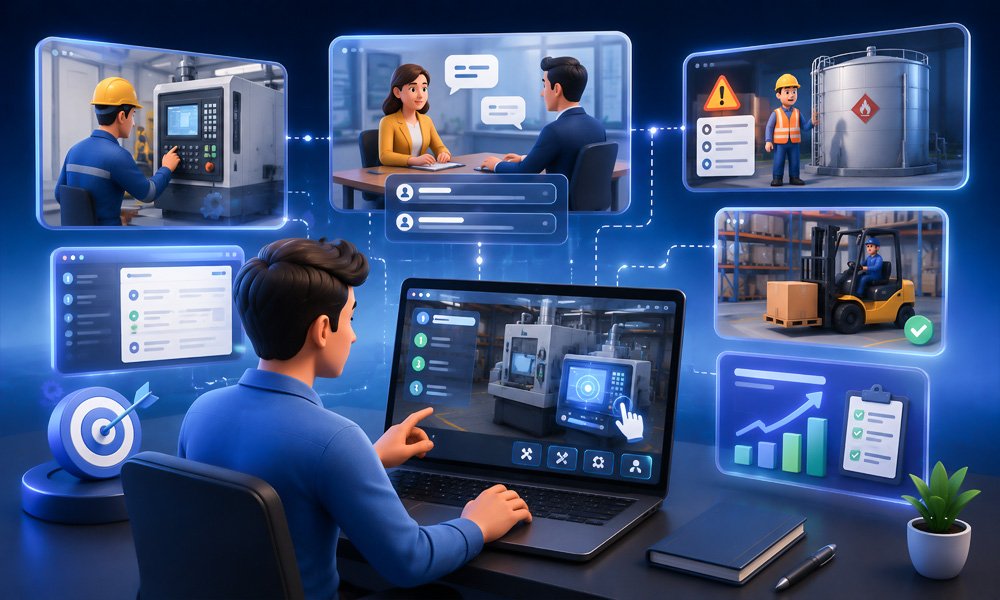
Practice Before Performance. Learn Without Risk.
Modern organizations need more than traditional online courses to build workforce capability. Employees are expected to operate sophisticated software, follow complex business processes, comply with strict regulations, troubleshoot technical issues, and make informed decisions in high-pressure situations. Reading content or watching videos alone rarely prepares learners for these real-world challenges.
This is where eLearning simulations become a powerful learning solution.
Simulation-based learning allows learners to actively practice tasks, make decisions, solve problems, and experience realistic workplace scenarios in a safe digital environment. Instead of simply learning what to do, employees learn how to do it through guided practice, immediate feedback, and repeated application.
At HexaLearn, we design and develop immersive eLearning Simulation Development Services that replicate real workplace environments, software applications, operational procedures, customer interactions, technical systems, and decision-making scenarios. Our simulations help organizations improve learner confidence, accelerate skill acquisition, reduce operational errors, and enhance overall business performance.
Whether you need software application simulations, process training, equipment operation, compliance scenarios, customer service simulations, sales conversations, or technical troubleshooting exercises, our experienced instructional designers, simulation specialists, multimedia developers, and learning consultants create engaging learning experiences tailored to your business objectives.
From onboarding new employees to upskilling experienced professionals, our custom simulation solutions enable learners to gain practical experience before applying their knowledge in the workplace—reducing risk while improving productivity and performance.
Why eLearning Simulations Are Transforming Corporate Learning
Organizations today operate in increasingly complex and technology-driven environments. Employees are expected to quickly learn new systems, adopt evolving processes, comply with industry regulations, and perform confidently from day one. Traditional training methods often struggle to bridge the gap between theoretical knowledge and real-world application.
Simulation-based learning addresses this challenge by creating interactive environments where learners actively perform tasks rather than passively consume information.
Instead of reading manuals or watching demonstrations, learners can:
- Practice Business Processes
- Navigate Enterprise Software
- Make Workplace Decisions
- Handle Customer Interactions
- Respond to Compliance Situations
- Operate Virtual Equipment
- Troubleshoot Technical Problems
- Complete Realistic Workflows
- Receive Instant Feedback
- Learn from Mistakes Without Real-World Consequences
This experiential approach significantly improves engagement, knowledge retention, confidence, and job readiness while minimizing operational risks.
Organizations across industries increasingly rely on simulation-based learning because it provides measurable improvements in employee performance, training effectiveness, and operational efficiency.
What Are eLearning Simulations?
An eLearning simulation is an interactive digital learning experience that replicates real-world environments, systems, processes, or workplace scenarios. It enables learners to practice skills, complete tasks, solve problems, and make decisions within a controlled and risk-free virtual environment.
Unlike conventional online training, simulations require learners to actively participate. Every interaction mirrors realistic workplace situations, allowing learners to understand the consequences of their actions, receive immediate feedback, and refine their skills through repetition.
Depending on training objectives, simulations may replicate:
- Enterprise Software Applications
- Manufacturing Processes
- Medical Procedures
- Customer Conversations
- Sales Negotiations
- Safety Protocols
- Machine Operations
- Technical Troubleshooting
- Financial Workflows
- Compliance Scenarios
- Leadership Challenges
- Decision-Making Situations
These immersive learning experiences allow employees to build competence before performing critical tasks in live work environments.
Why Organizations Invest in eLearning Simulation Development
Businesses invest in simulation-based learning because it delivers measurable improvements in workforce capability while reducing training costs and operational risks.
Professionally developed simulations enable organizations to:
- Accelerate Employee Onboarding
- Improve Software Adoption
- Reduce Workplace Errors
- Strengthen Compliance Awareness
- Enhance Technical Skills
- Standardize Business Processes
- Increase Learner Engagement
- Improve Knowledge Retention
- Build Employee Confidence
- Reduce Instructor Dependency
- Support Continuous Learning
- Enable Self-Paced Practice
- Improve Decision-Making Abilities
- Increase Productivity
- Deliver Measurable Business Outcomes
By providing realistic practice opportunities, simulations prepare employees for actual workplace responsibilities before they encounter them on the job.
Why Choose HexaLearn for eLearning Simulation Development?
Developing effective simulations requires expertise in instructional design, learning psychology, user experience, multimedia development, and modern eLearning technologies. At HexaLearn, we combine these capabilities to create simulation-based learning experiences that are engaging, technically robust, and aligned with business goals.
Experienced Simulation Development Specialists
Our multidisciplinary team includes instructional designers, simulation developers, multimedia designers, software specialists, quality analysts, and learning consultants with extensive experience delivering custom simulation solutions across diverse industries.
We transform complex workflows, software systems, and operational procedures into intuitive digital experiences that help learners gain practical skills efficiently.
Business-Driven Learning Solutions
Every simulation project begins with understanding your organization's unique objectives.
We analyze:
- Business Goals
- Performance Challenges
- Learner Roles
- Existing Training Materials
- Software Environments
- Operational Workflows
- Compliance Requirements
- Success Metrics
This consultative approach ensures each simulation directly supports business performance rather than simply delivering information.
Instructionally Designed Simulations
Effective simulations are built on proven instructional design principles.
Every learning experience we create incorporates:
- Clear Learning Objectives
- Guided Learning Pathways
- Progressive Skill Development
- Scenario-Based Practice
- Realistic Decision Points
- Contextual Feedback
- Knowledge Reinforcement
- Performance-Based Assessments
Our instructional strategies help learners understand concepts, apply knowledge, and develop confidence through hands-on practice.
Realistic Software and Process Replication
Our simulations closely replicate the tools, systems, and workflows learners encounter in their daily work.
We develop simulations for:
- Enterprise Applications
- CRM Platforms
- ERP Systems
- HRMS Software
- Healthcare Systems
- Manufacturing Processes
- Financial Platforms
- Customer Support Tools
- Learning Management Systems
- Internal Business Applications
This realism allows learners to build familiarity before using production environments.
Interactive Learning Experiences
Modern learners expect engaging digital experiences.
Our simulations include:
- Clickable Interfaces
- Guided Workflows
- Branching Scenarios
- Interactive Hotspots
- Drag-And-Drop Activities
- Decision-Making Exercises
- Process Walkthroughs
- Knowledge Checks
- Performance Feedback
- Gamified Learning Elements
These interactive components improve learner engagement while reinforcing practical skills.
Technology-Ready Development
HexaLearn develops simulations compatible with leading eLearning standards and authoring technologies.
Our expertise includes:
- Articulate Storyline 360
- Articulate Rise 360
- Adobe Captivate
- HTML5
- SCORM
- xAPI
- Cmi5
- Responsive Learning Design
- Mobile-Compatible Simulations
- LMS Integration
Our solutions integrate seamlessly with modern Learning Management Systems and enterprise learning ecosystems.
Our eLearning Simulation Development Services
Every organization has unique learning requirements, operational workflows, and technology environments. HexaLearn offers a comprehensive portfolio of simulation development services that address diverse training needs across industries.
1. Software Simulation Development
Software applications are central to modern business operations. Employees often need hands-on experience before working with enterprise systems.
We develop software simulations for:
- ERP Systems
- CRM Platforms
- HR Software
- Banking Applications
- Healthcare Software
- Manufacturing Systems
- Customer Support Platforms
- Internal Enterprise Applications
- Cloud-Based Software
- Web Applications
Our simulations provide learners with guided demonstrations, hands-on practice, and performance assessments that improve software proficiency while reducing implementation risks.
2. Scenario-Based Simulations
Scenario-based learning places employees in realistic workplace situations where they must analyze information, make decisions, and experience the consequences of their choices.
These simulations are ideal for:
- Leadership Development
- Customer Service
- Compliance Training
- Sales Enablement
- Conflict Resolution
- Workplace Ethics
- Risk Management
- Performance Management
- Communication Skills
- Problem-Solving Training
By replicating authentic business situations, learners develop stronger decision-making and critical thinking abilities.
3. Process Simulation Development
Business processes often involve multiple steps, stakeholders, approvals, and decision points. Process simulations help employees understand complete workflows while practicing each stage in a controlled environment.
Our process simulations support:
- Standard Operating Procedures (SOPs)
- Manufacturing Workflows
- Quality Assurance Processes
- Procurement Procedures
- Finance Operations
- Supply Chain Management
- Customer Onboarding
- Claims Processing
- Audit Procedures
- Regulatory Compliance Workflows
These simulations help organizations improve operational consistency while reducing costly process errors.
4. Technical Training Simulations
Technical roles require precision, accuracy, and practical experience. Our technical simulations enable learners to safely practice specialized tasks before applying them in real-world environments.
We create simulations for:
- Equipment Operation
- System Configuration
- Technical Troubleshooting
- Maintenance Procedures
- Laboratory Workflows
- Network Administration
- Engineering Processes
- Product Installation
- Diagnostics
- Technical Support
Learners gain valuable experience through repeated practice without risking equipment, safety, or business operations.
Our eLearning Simulation Development Services & Development Process
Comprehensive eLearning Simulation Development Services
Every organization has unique training objectives, business processes, software environments, and learner requirements. At HexaLearn, we build custom simulation-based learning solutions that closely replicate real workplace situations, enabling learners to develop practical skills before applying them in their jobs.
Our simulation development services are designed to improve employee confidence, reduce operational risks, accelerate learning, and deliver measurable business outcomes.
1. Software Simulation Development
Modern organizations rely on numerous software applications to manage daily operations. However, introducing new systems often creates learning challenges, reduces productivity, and increases support requests.
Our software simulations provide employees with guided, hands-on practice before they begin using live applications.
We develop simulations for:
- ERP Systems
- CRM Platforms
- HRMS Applications
- Learning Management Systems
- Banking Software
- Insurance Platforms
- Healthcare Applications
- Manufacturing Systems
- Finance Software
- Procurement Systems
- Government Applications
- Custom Enterprise Software
Our software simulations typically include:
- Guided Demonstrations
- Step-By-Step Practice
- Interactive Try Mode
- Independent Assessment Mode
- Performance Feedback
- Error Correction
- Tips and Hints
- Knowledge Checks
Employees become comfortable navigating systems without affecting production data or business operations.
2. Scenario-Based Learning Simulations
Scenario-based simulations place learners into realistic workplace situations where every decision influences the outcome.
Instead of memorizing procedures, learners experience situations that mirror real business challenges.
Common scenario simulations include:
- Customer Complaints
- Sales Conversations
- Leadership Situations
- Employee Coaching
- Compliance Decisions
- Workplace Ethics
- Conflict Resolution
- Cybersecurity Awareness
- Healthcare Patient Interactions
- Financial Advisory Situations
Each scenario contains:
- Characters
- Dialogue
- Multiple Decision Paths
- Immediate Feedback
- Alternative Outcomes
- Reflection Activities
- Final Evaluation
These simulations develop critical thinking and decision-making skills while improving learner engagement.
3. Interactive Process Simulations
Business processes often involve multiple stakeholders, approvals, dependencies, and workflows.
Process simulations help learners understand how every activity contributes to successful business operations.
Examples include:
- Employee Onboarding
- Procurement Process
- Purchase Approvals
- Quality Inspections
- Manufacturing Workflow
- Incident Management
- Audit Process
- Customer Onboarding
- Insurance Claims
- Loan Processing
- Supply Chain Operations
Learners can repeatedly practice complete workflows until they gain confidence.
4. Technical Training Simulations
Technical professionals require extensive practical experience before performing complex tasks independently.
Our technical simulations allow employees to safely practice technical procedures in a virtual environment.
Training areas include:
- Equipment Maintenance
- Electrical Systems
- Mechanical Operations
- Network Configuration
- Cloud Deployment
- Software Installation
- Product Configuration
- Medical Equipment
- Laboratory Procedures
- Engineering Workflows
These simulations reduce costly mistakes while improving technical competence.
5. Equipment Operation Simulations
Training employees directly on expensive or hazardous equipment can be risky and expensive.
Simulation-based equipment training enables learners to become familiar with operational procedures before working on actual machinery.
Examples include:
- CNC Machines
- Manufacturing Equipment
- Industrial Robots
- Medical Devices
- Laboratory Equipment
- Aviation Systems
- Heavy Machinery
- Warehouse Equipment
- Construction Equipment
- Energy Plant Operations
Learners understand equipment controls, safety procedures, troubleshooting techniques, and operational workflows in a completely risk-free environment.
6. Compliance Training Simulations
Compliance training becomes significantly more engaging when learners actively participate rather than simply reading policies.
Our compliance simulations cover:
- Anti-Bribery
- Anti-Money Laundering
- GDPR
- HIPAA
- OSHA
- Information Security
- Workplace Harassment
- Code of Conduct
- Environmental Compliance
- Financial Regulations
Employees experience realistic situations that require ethical judgment and policy-based decision-making.
7. Customer Service Simulations
Customer-facing employees encounter numerous situations that require empathy, communication, and problem-solving.
Customer service simulations allow representatives to practice conversations before interacting with real customers.
Simulation examples include:
- Complaint Resolution
- Product Recommendations
- Upselling
- Difficult Customers
- Escalation Handling
- Technical Support
- Billing Queries
- Service Recovery
These simulations improve customer satisfaction while reducing operational errors.
8. Sales Training Simulations
Sales professionals benefit from repeated practice before interacting with prospects.
Sales simulations include:
- Prospecting
- Discovery Calls
- Product Demonstrations
- Negotiation
- Objection Handling
- Closing Techniques
- Cross-Selling
- Account Management
Learners receive personalized feedback on their sales decisions, helping them refine their approach.
9. Safety Training Simulations
Safety training is most effective when employees experience realistic workplace hazards in a controlled environment.
Safety simulations cover:
- Fire Safety
- Lockout/tagout
- PPE Usage
- Hazard Identification
- Chemical Handling
- Electrical Safety
- Emergency Response
- Machine Safety
- Construction Safety
- Workplace Evacuation
Employees learn correct responses without exposing themselves or others to danger.
10. Product Training Simulations
Organizations frequently launch new products, making effective product education essential.
Simulation-based product training helps learners understand:
- Product Features
- Product Configuration
- Installation
- Demonstrations
- Competitive Positioning
- Customer Conversations
- Troubleshooting
- Product Support
These simulations improve sales confidence and customer interactions.
11. AI-Powered eLearning Simulations
Artificial Intelligence is transforming simulation-based learning by creating more adaptive and personalized experiences.
At HexaLearn, we leverage AI to enhance simulation development while ensuring every learning experience is reviewed and validated by experienced instructional designers.
Our AI-assisted capabilities include:
- Personalized Learning Pathways
- Adaptive Difficulty Levels
- Intelligent Learner Feedback
- Automated Content Recommendations
- Scenario Generation
- Assessment Suggestions
- Learning Analytics
- Performance Insights
Human expertise remains central to every project, ensuring instructional quality and business relevance.
12. Mobile Learning Simulations
Today's workforce expects learning to be accessible anytime and anywhere.
We develop responsive simulations optimized for:
- Smartphones
- Tablets
- Laptops
- Desktop Computers
Our mobile simulations feature:
- Touch-Friendly Interfaces
- Responsive Layouts
- Offline Compatibility (Where Applicable)
- Microlearning Modules
- Fast Loading Performance
Employees can continue practicing wherever they are.
Our End-to-End eLearning Simulation Development Process
Creating an effective simulation involves much more than replicating screens or designing interactions. It requires a structured methodology that aligns business goals, instructional strategies, user experience, and technology.
At HexaLearn, we follow a proven development framework that ensures every simulation delivers measurable learning outcomes.
Step 1: Discovery & Learning Needs Analysis
Every successful simulation project begins with understanding why the training is needed.
Our consultants collaborate with stakeholders to identify:
- Business Objectives
- Training Challenges
- Learner Personas
- Existing Performance Gaps
- Technology Ecosystem
- Success Metrics
- Compliance Requirements
- Project Timelines
This phase ensures the simulation addresses real business needs rather than simply digitizing existing content.
Step 2: Content Analysis
Our instructional designers review all available learning resources, including:
- Standard Operating Procedures (SOPs)
- Training Manuals
- Powerpoint Presentations
- Software Documentation
- Process Maps
- Technical Manuals
- Existing eLearning Courses
- Product Guides
- Videos
- SME Interviews
We identify critical tasks, knowledge gaps, decision points, and opportunities for simulation-based practice.
Step 3: Audience Analysis
Understanding the learner is essential for creating relevant simulations.
We evaluate:
- Job Roles
- Experience Levels
- Technical Proficiency
- Learning Preferences
- Device Usage
- Geographic Distribution
- Language Requirements
- Accessibility Needs
This analysis helps us design learner-centric experiences that maximize engagement and knowledge transfer.
Step 4: Simulation Strategy & Instructional Design
Our instructional designers define the overall simulation approach, including:
- Learning Objectives
- Simulation Type
- User Journey
- Interaction Strategy
- Scenario Design
- Assessment Plan
- Feedback Mechanisms
- Multimedia Requirements
- Accessibility Considerations
Every simulation is aligned with measurable business and learning outcomes.
Step 5: Storyboarding & Experience Design
Before development begins, we create detailed simulation storyboards that outline every learner interaction.
Storyboards include:
- Screen Layouts
- Navigation Flow
- On-Screen Instructions
- Narration Scripts
- Decision Points
- Branching Logic
- Visual References
- Assessment Interactions
- Developer Notes
This blueprint ensures alignment among stakeholders and reduces production revisions.
Step 6: UI/UX Design & Prototyping
Our designers create intuitive interfaces that closely resemble real workplace environments.
The prototype phase allows stakeholders to review:
- User Interface
- Navigation
- Interaction Flow
- Visual Consistency
- Accessibility
- Branding
- Learner Experience
Early validation helps accelerate development while minimizing rework.
Step 7: Simulation Development
Once the prototype is approved, our development team builds the complete simulation using industry-leading authoring tools and technologies.
Development activities include:
- Interactive Programming
- Software Replication
- Scenario Implementation
- Multimedia Integration
- Animations
- Voice-Over Synchronization
- Responsive Design
- LMS Compatibility
Every component is optimized for performance, usability, and scalability.
Step 8: Quality Assurance & Testing
Before deployment, each simulation undergoes comprehensive testing to ensure quality and reliability.
Our QA process verifies:
- Instructional Accuracy
- Functional Performance
- Navigation
- Branching Logic
- Assessment Scoring
- Multimedia Synchronization
- Accessibility Compliance
- Browser Compatibility
- Mobile Responsiveness
- LMS Functionality
This rigorous process helps deliver a seamless learning experience.
Step 9: LMS Integration & Deployment
Our simulations are designed for seamless integration with modern Learning Management Systems.
We support:
- SCORM 1.2
- SCORM 2004
- xAPI (Tin Can)
- Cmi5
- AICC (Where Required)
We assist with:
- LMS Deployment
- User Testing
- Tracking Configuration
- Completion Reporting
- Analytics Setup
- Technical Support
Step 10: Continuous Improvement & Optimization
Learning doesn't end after deployment. We help organizations measure effectiveness and continuously improve their simulation programs.
Our post-deployment services include:
- Learner Analytics
- Performance Reporting
- Feedback Analysis
- Content Updates
- Version Enhancements
- Localization
- New Feature Additions
- Ongoing Maintenance
By analyzing learner behavior and business outcomes, we help organizations maximize the long-term value of their simulation-based training investments.
Instructional Design Methodologies That Power Effective eLearning Simulations
A successful simulation is much more than an interactive activity. It is a carefully designed learning experience that aligns business goals, learner needs, instructional strategies, and measurable outcomes.
At HexaLearn, every simulation is built using globally recognized instructional design methodologies that encourage learners to think critically, apply knowledge, and perform confidently in real-world situations.
ADDIE Methodology
Our simulation development process is built on the internationally recognized ADDIE framework.
Analysis
We begin by understanding:
- Business Objectives
- Learner Challenges
- Skill Gaps
- Existing Knowledge
- Performance Expectations
- Technology Ecosystem
- Compliance Requirements
This phase establishes the foundation for a simulation that solves real business problems rather than simply delivering content.
Design
Our instructional designers create the complete learning blueprint.
This includes:
- Learning Objectives
- Simulation Strategy
- User Journeys
- Interaction Design
- Assessment Planning
- Feedback Mechanisms
- Multimedia Recommendations
Every design decision is guided by learner engagement and business impact.
Development
Our development team transforms approved designs into fully interactive simulations using modern authoring tools and technologies.
Development includes:
- Interactive Programming
- UI Implementation
- Multimedia Production
- Branching Scenarios
- Assessment Integration
- LMS Compatibility
Implementation
Once developed, simulations are deployed within the organization's learning ecosystem.
Implementation includes:
- LMS Deployment
- User Testing
- Administrator Training
- Technical Support
- Analytics Configuration
Evaluation
Continuous evaluation helps improve learning effectiveness.
We measure:
- Learner Completion
- Assessment Performance
- Simulation Interactions
- Skill Improvement
- Learner Feedback
- Business Impact
These insights guide future enhancements and optimization.
Successive Approximation Model (SAM)
Organizations often require rapid development cycles.
For projects with evolving requirements, we adopt the Successive Approximation Model (SAM), which emphasizes iterative design and continuous stakeholder collaboration.
Benefits include:
- Faster Prototyping
- Frequent Client Reviews
- Early Feedback
- Reduced Rework
- Agile Development
- Better Stakeholder Engagement
- Improved Project Transparency
Bloom's Taxonomy
Our simulations are structured to progressively develop learner capability using Bloom's Taxonomy.
Learning activities encourage learners to:
- Remember
- Understand
- Apply
- Analyze
- Evaluate
- Create
Rather than focusing solely on knowledge acquisition, our simulations encourage learners to solve problems, make informed decisions, and perform workplace tasks confidently.
Adult Learning Principles
Adults learn best when training is practical, relevant, and immediately applicable.
Our simulations incorporate:
- Real Workplace Scenarios
- Self-Directed Exploration
- Immediate Feedback
- Problem-Solving Activities
- Practical Application
- Performance Support
- Reflection Opportunities
These principles help learners connect training directly to their day-to-day responsibilities.
Experiential Learning
People learn more effectively through experience than passive observation.
Simulation-based learning enables learners to:
- Practice Repeatedly
- Learn from Mistakes
- Experiment Safely
- Build Confidence
- Improve Decision-Making
- Apply Knowledge Immediately
Experiential learning bridges the gap between theory and workplace performance.
Scenario-Based Learning
Scenario-based simulations immerse learners in realistic workplace situations.
Typical scenarios include:
- Customer Interactions
- Compliance Incidents
- Leadership Decisions
- Ethical Dilemmas
- Technical Troubleshooting
- Operational Challenges
- Safety Incidents
Learners evaluate information, make decisions, and experience realistic outcomes that reinforce critical thinking and judgment.
Watch–Try–Do–Test Simulation Model
One of the most effective approaches for software and process training is the Watch–Try–Do–Test model.
This structured methodology allows learners to build confidence through progressive practice.
Watch Mode
Learners observe an expert completing a task while guided by on-screen instructions and narration.
This phase introduces:
- System Navigation
- Process Flow
- Best Practices
- Correct Procedures
Try Mode
Learners perform the same task with guidance.
The simulation provides:
- Hints
- Visual Prompts
- Step Validation
- Corrective Feedback
This phase encourages active participation while minimizing frustration.
Do Mode
Learners complete the activity independently without assistance.
This reinforces:
- Task Accuracy
- Confidence
- Workflow Understanding
- System Familiarity
Test Mode
Learners demonstrate competence by completing tasks without guidance.
Performance is evaluated based on:
- Accuracy
- Completion Time
- Error Rate
- Decision Quality
Assessment results can be reported directly to the Learning Management System.
Technologies We Use
Our technology expertise enables us to develop scalable, responsive, and future-ready simulation solutions.
Articulate Storyline 360
One of the industry's leading authoring platforms.
Ideal for:
- Software Simulations
- Scenario-Based Learning
- Branching Simulations
- Technical Training
- Compliance Courses
Articulate Rise 360
Perfect for:
- Responsive Simulations
- Mobile Learning
- Microlearning
- Product Education
- Process Training
Adobe Captivate
Widely used for:
- Software Demonstrations
- Screen Simulations
- Responsive Projects
- Technical Learning
- System Training
HTML5 Development
Custom HTML5 development provides flexibility for highly interactive simulations requiring advanced functionality.
Ideal for:
- Enterprise Applications
- Custom Workflows
- Interactive Dashboards
- Complex Business Simulations
JavaScript Integration
JavaScript enables advanced interactions such as:
- Dynamic Scoring
- Personalized Learning Paths
- Interactive Calculations
- Adaptive Feedback
- Advanced Animations
xAPI (Tin Can API)
Traditional SCORM tracks course completion, while xAPI provides deeper learning analytics.
Organizations can monitor:
- Learner Decisions
- Simulation Attempts
- Time Spent
- Errors
- Repeated Practice
- Behavioral Trends
This provides valuable insights into learner performance beyond completion rates.
SCORM Compliance
Our simulations support:
- SCORM 1.2
- SCORM 2004
This ensures compatibility with most Learning Management Systems.
cmi5 Support
For organizations using modern LMS platforms, we also support cmi5 standards to provide enhanced tracking and interoperability.
Responsive Design
Every simulation is optimized for multiple devices.
Supported platforms include:
- Desktop
- Laptop
- Tablet
- Smartphone
Responsive interfaces improve accessibility and learner convenience.
AI-Enhanced Simulation Development
Artificial Intelligence is transforming simulation-based learning by enabling greater personalization, efficiency, and data-driven improvements.
At HexaLearn, AI is used to accelerate development and enhance learner experiences while instructional designers retain full control over learning quality.
Our AI-assisted capabilities include:
- Personalized Learning Recommendations
- Adaptive Simulation Pathways
- Intelligent Learner Feedback
- Automated Assessment Suggestions
- Scenario Generation Support
- Content Summarization
- Localization Assistance
- Learning Analytics
Every AI-assisted output is reviewed by experienced instructional designers to ensure instructional accuracy, contextual relevance, and alignment with business objectives.
Industries We Serve
Simulation-based learning is valuable across industries where employees must apply knowledge accurately, consistently, and safely.
Manufacturing
Simulation training supports:
- Equipment Operation
- SOP Training
- Lean Manufacturing
- Quality Assurance
- Workplace Safety
- Maintenance Procedures
- Production Workflows
Healthcare & Pharmaceuticals
We develop simulations for:
- Clinical Procedures
- Patient Interactions
- Medical Devices
- Laboratory Practices
- Infection Control
- Regulatory Compliance
- Pharmaceutical Sales
Banking, Financial Services & Insurance (BFSI)
Training areas include:
- KYC
- AML
- Risk Management
- Fraud Prevention
- Customer Service
- Regulatory Compliance
- Product Knowledge
Information Technology
Simulation solutions include:
- Software Deployment
- Cloud Platforms
- Cybersecurity
- Technical Support
- Programming Environments
- Devops Workflows
- System Administration
Retail & E-Commerce
We create simulations for:
- Product Training
- Customer Engagement
- Store Operations
- Inventory Management
- Sales Techniques
- Point-Of-Sale Systems
Logistics & Supply Chain
Simulation training includes:
- Warehouse Operations
- Fleet Management
- Inventory Control
- Distribution Processes
- Transportation Safety
- Procurement Workflows
Energy & Utilities
Training focuses on:
- Plant Operations
- Safety Compliance
- Equipment Maintenance
- Emergency Response
- Operational Procedures
Government & Public Sector
We support training initiatives for:
- Citizen Services
- Policy Implementation
- Administrative Procedures
- Compliance
- Digital Transformation
Education
Simulation-based learning enhances:
- Virtual Laboratories
- Practical Exercises
- Faculty Development
- Technical Education
- Professional Certification
Our Quality Assurance Framework
Every simulation undergoes rigorous quality checks before deployment.
Instructional Review
We verify:
- Learning Objective Alignment
- Content Sequencing
- Scenario Realism
- Instructional Flow
- Learner Engagement
Functional Testing
We validate:
- Navigation
- Interactions
- Buttons
- Variables
- Branching Logic
- Assessments
Technical Testing
Our QA team ensures compatibility across:
- Browsers
- Operating Systems
- Mobile Devices
- LMS Platforms
Accessibility Review
Inclusive learning is a priority.
Our accessibility review includes:
- Keyboard Navigation
- Screen Reader Compatibility
- Color Contrast
- Alternative Text
- Captions
- Logical Reading Order
Client Review & UAT
Before launch, stakeholders review the simulation to verify:
- Business Accuracy
- Branding Consistency
- Process Alignment
- Regulatory Compliance
- Learning Objectives
This collaborative approach reduces production risks and supports successful deployment.
Flexible Engagement Models
Every organization has different project scopes, timelines, and resource requirements.
HexaLearn offers multiple engagement models to meet these needs.
Fixed Price Model
Best suited for:
- Well-Defined Projects
- Compliance Training
- Product Simulations
- Software Training
Time & Material Model
Ideal for:
- Evolving Requirements
- Continuous Enhancements
- Agile Development
- Long-Term Initiatives
Dedicated Development Team
A dedicated team of instructional designers, simulation developers, multimedia specialists, QA professionals, and project managers works exclusively on your learning initiatives.
Suitable for:
- Enterprise Learning Programs
- Digital Transformation
- Large-Scale Simulation Development
- Ongoing Workforce Training
Hybrid Engagement Model
Combines predictable milestones with flexible development to balance cost, speed, and adaptability.
Complimentary Simulation Proof of Concept (PoC)
Choosing the right simulation development partner is an important investment.
To help organizations evaluate our capabilities, HexaLearn offers a complimentary 5–8 screen Simulation Proof of Concept (PoC) for qualified opportunities.
Using a sample of your training content, our team develops a simulation that demonstrates:
- Instructional Design Approach
- User Interface Design
- Interactive Workflow
- Scenario Structure
- Assessment Examples
- Feedback Mechanisms
- Multimedia Integration
- Technical Implementation
This Proof of Concept enables stakeholders to assess our design quality, instructional expertise, and development approach before committing to a larger project.
Frequently Asked Questions (FAQs)
1. What are eLearning simulations?
eLearning simulations are interactive digital learning experiences that replicate real-world tasks, software applications, workplace scenarios, business processes, or technical procedures. They enable learners to practice skills, make decisions, and receive immediate feedback in a safe, risk-free environment before applying their knowledge on the job.
2. How do eLearning simulations improve employee performance?
Simulation-based learning enables employees to learn by doing rather than simply reading or watching content. By practicing realistic tasks and receiving immediate feedback, learners develop confidence, improve decision-making, reduce errors, and retain knowledge more effectively.
3. What types of eLearning simulations does HexaLearn develop?
We develop a wide range of simulation-based learning solutions, including:
- Software Simulations
- Scenario-Based Simulations
- Process Simulations
- Technical Training Simulations
- Equipment Operation Simulations
- Customer Service Simulations
- Sales Simulations
- Compliance Simulations
- Safety Training Simulations
- Product Training Simulations
- Leadership Simulations
- AI-assisted Simulations
4. Which authoring tools do you use for simulation development?
Our team develops simulations using industry-leading tools and technologies, including:
- Articulate Storyline 360
- Articulate Rise 360
- Adobe Captivate
- HTML5
- Javascript
- SCORM
- xAPI
- Cmi5
The technology stack is selected based on your learning objectives, technical environment, and LMS requirements.
5. Can you develop software application simulations?
Yes. We specialize in software simulation development for enterprise and custom applications.
Examples include:
- SAP
- Oracle
- Salesforce
- Microsoft Dynamics
- Workday
- Servicenow
- CRM Platforms
- ERP Systems
- HRMS Applications
- Proprietary Enterprise Software
Our simulations help employees master software workflows before working in live production environments.
6. Are your simulations compatible with Learning Management Systems (LMS)?
Yes. Our simulations are compatible with most modern LMS platforms and support:
- SCORM 1.2
- SCORM 2004
- xAPI
- Cmi5
We also assist with deployment, testing, and reporting configuration.
7. Can simulations be accessed on mobile devices?
Absolutely.
Our simulations are designed with responsive layouts that work seamlessly across:
- Desktop Computers
- Laptops
- Tablets
- Smartphones
This allows learners to access training anytime and anywhere.
8. Do you create multilingual simulations?
Yes.
We support multilingual simulation development through:
- Content Translation
- Localization
- Multilingual Voice-Over
- Regional Customization
- Cultural Adaptation
This enables organizations to deliver consistent training across global teams.
9. How long does it take to develop an eLearning simulation?
Project timelines depend on several factors, including:
- Simulation Complexity
- Number of Modules
- Software Environment
- Multimedia Requirements
- Review Cycles
- SME Availability
After reviewing your requirements, we provide a detailed project plan with timelines and milestones.
10. Can you convert existing classroom training into simulations?
Yes.
We transform existing learning assets into engaging simulation-based experiences, including:
- Instructor-Led Training (ILT)
- Powerpoint Presentations
- Word Documents
- PDFs
- SOPs
- User Manuals
- Product Documentation
- Existing eLearning Courses
- Videos
11. Do you develop branching and decision-based simulations?
Yes.
We create branching simulations where learners experience different outcomes based on the decisions they make.
These simulations are particularly effective for:
- Leadership Training
- Compliance
- Customer Service
- Healthcare
- Sales Enablement
- Technical Troubleshooting
12. How do you ensure simulation quality?
Every project undergoes multiple quality reviews covering:
- Instructional Design
- Functional Testing
- Technical Validation
- Accessibility
- Browser Compatibility
- Mobile Responsiveness
- LMS Compatibility
- Client Approval
This structured quality process ensures reliable and engaging learning experiences.
13. Do you use AI in simulation development?
Yes.
We use AI to enhance development efficiency through:
- Content Organization
- Scenario Ideation
- Assessment Suggestions
- Personalized Learning Pathways
- Analytics Support
All AI-assisted content is reviewed and refined by experienced instructional designers to ensure instructional effectiveness and business alignment.
14. Which industries benefit most from simulation-based learning?
Simulation-based learning is widely used across industries, including:
- Manufacturing
- Healthcare
- Pharmaceuticals
- BFSI
- Information Technology
- Retail
- Logistics
- Telecommunications
- Energy & Utilities
- Government
- Education
- Professional Services
15. Why should organizations outsource eLearning simulation development?
Outsourcing provides access to specialized instructional design expertise, advanced technologies, and experienced simulation developers, allowing organizations to accelerate project delivery, improve learning quality, and reduce development costs without expanding internal teams.
Why Organizations Choose HexaLearn
Organizations partner with HexaLearn because we combine instructional design expertise, simulation development capabilities, and business understanding to create impactful learning experiences that deliver measurable outcomes.
Our strengths include:
Experienced Simulation Specialists
Our team includes instructional designers, multimedia experts, software simulation developers, QA specialists, UI/UX designers, and learning consultants with extensive experience across industries.
Learner-Centric Design
We design simulations that prioritize engagement, usability, accessibility, and real-world application, helping learners build confidence through meaningful practice.
Business-Focused Approach
Every simulation aligns with your business goals, operational workflows, compliance requirements, and performance expectations to ensure measurable training outcomes.
Modern Technology Expertise
We leverage industry-leading authoring tools and technologies to create scalable, responsive, and future-ready simulations that integrate seamlessly with your learning ecosystem.
Agile Development Methodology
Our collaborative and iterative approach promotes transparency, faster feedback cycles, and efficient project delivery while maintaining high quality.
Enterprise-Grade Quality Assurance
Each simulation undergoes comprehensive instructional, technical, functional, and accessibility reviews to ensure reliability and learner satisfaction.
Flexible Engagement Models
Whether you require a single simulation or enterprise-wide learning transformation, we offer flexible engagement models tailored to your scope, budget, and timeline.
Long-Term Learning Partnership
Beyond project delivery, we provide ongoing maintenance, enhancements, localization, analytics support, and consultation to maximize the value of your digital learning investments.
Related eLearning Services
HexaLearn provides end-to-end digital learning solutions that complement simulation development, enabling organizations to build comprehensive learning ecosystems.
Our related services include:
- Custom eLearning Development
- Rapid eLearning Development
- Instructional Design Services
- eLearning Storyboarding Services
- eLearning Content Development
- Microlearning Development
- Mobile Learning Solutions
- Video-Based Learning
- Gamification Services
- Learning Management System (LMS) Development
- Assessment Development
- Translation & Localization
- AI-Powered eLearning Solutions
- Learning Consulting
- Multimedia Development
- Quality Assurance & Testing
- Legacy Course Conversion
- Content Modernization
Why Simulation-Based Learning Is the Future of Corporate Training
As organizations embrace digital transformation, employees are expected to adapt quickly to new technologies, processes, and business challenges. Traditional training methods often struggle to provide the hands-on experience required to build workplace confidence and competence.
Simulation-based learning addresses this need by enabling learners to practice real-world tasks, make informed decisions, and develop critical skills within a controlled, risk-free environment. By replicating authentic workplace situations, simulations help bridge the gap between theoretical knowledge and practical application.
Organizations that invest in simulation-based learning benefit from faster onboarding, improved software adoption, higher learner engagement, reduced operational errors, stronger compliance, and measurable improvements in workforce performance. Simulation-based training is no longer an optional enhancement—it has become a strategic component of modern learning and development initiatives.
Ready to Build Engaging eLearning Simulations?
Whether you're training employees on enterprise software, operational processes, technical procedures, customer interactions, or compliance requirements, HexaLearn helps you create immersive simulation-based learning experiences that deliver measurable business results.
From instructional design and scenario development to multimedia production, quality assurance, and LMS deployment, our team works closely with you to develop scalable, learner-centric simulations aligned with your organizational goals.
Request a Complimentary Simulation Consultation
Planning your next simulation-based learning initiative? Our experts can help you:
- Assess Your Training Requirements
- Identify the Right Simulation Strategy
- Recommend Suitable Technologies
- Improve Learner Engagement
- Reduce Training Risks
- Accelerate Workforce Readiness
- Optimize Development Costs
Schedule a consultation to explore how simulation-based learning can transform your organization's training programs.
Let's Build Learning Experiences That Mirror the Real World
Empower your workforce with interactive, realistic, and results-driven eLearning simulations that improve skills, confidence, and performance.
Talk to Our Simulation Experts Today
Final Conclusion
Effective learning goes beyond delivering information—it prepares people to perform with confidence in real-world situations. eLearning simulations provide learners with the opportunity to practice, make decisions, solve problems, and refine their skills in a safe, interactive environment before applying them in the workplace.
At HexaLearn, we combine instructional design expertise, industry knowledge, and advanced eLearning technologies to develop custom simulation solutions that align with your business goals and learning objectives. From software simulations and technical training to scenario-based learning and process simulations, our solutions help organizations improve workforce capability, reduce operational risks, and achieve measurable training outcomes.
Whether you are modernizing existing programs or launching a new digital learning initiative, HexaLearn is your trusted partner for designing scalable, engaging, and high-impact eLearning simulations that support long-term business success.
Schedule a demo with our eLearning experts.