

Transforming Corporate Learning with Intelligent, Personalized, and Scalable Digital Learning Solutions
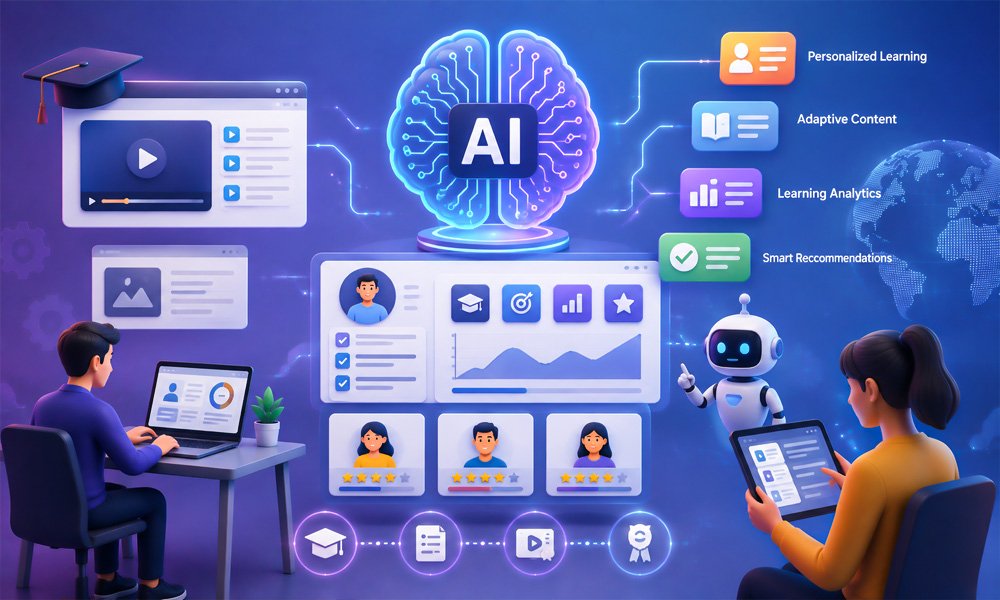
Transform Learning with Artificial Intelligence
Artificial Intelligence (AI) is redefining how organizations design, deliver, manage, and optimize digital learning. Traditional eLearning has already enabled businesses to scale training beyond classrooms, but today's workforce expects learning experiences that are more personalized, engaging, adaptive, and data-driven. AI empowers organizations to meet these expectations by automating repetitive tasks, generating learning content, personalizing learner journeys, providing intelligent recommendations, and delivering actionable insights that improve business performance.
As enterprises continue their digital transformation initiatives, AI in eLearning has become more than a technology trend—it is a strategic capability that helps organizations build a future-ready workforce. From employee onboarding and compliance training to leadership development, technical upskilling, customer education, and partner enablement, AI enables learning ecosystems that continuously adapt to learner needs while improving efficiency for learning and development (L&D) teams.
At HexaLearn, we combine instructional design expertise, custom eLearning development, learning technologies, and responsible AI practices to create intelligent learning experiences that align with organizational goals. Our AI-powered learning solutions help businesses accelerate course development, personalize training, automate learning workflows, improve learner engagement, and generate measurable learning outcomes without compromising instructional quality.
Whether you are beginning your AI adoption journey or expanding an existing digital learning ecosystem, HexaLearn helps you implement AI responsibly while maintaining human expertise, governance, and instructional excellence.
Why AI is Transforming eLearning
The modern workplace is evolving faster than ever. New technologies, changing regulations, hybrid work environments, and continuous skill development require organizations to deliver learning at unprecedented speed and scale. Traditional learning development processes often struggle to keep pace with these demands, leading to lengthy development cycles, inconsistent learner experiences, and limited personalization.
Artificial Intelligence addresses these challenges by introducing intelligent automation and data-driven decision-making into every stage of the learning lifecycle. Rather than replacing instructional designers or learning professionals, AI augments their capabilities by accelerating repetitive tasks, uncovering learner insights, and enabling more adaptive learning experiences.
Organizations are increasingly adopting AI in eLearning because it helps them:
- Personalize Learning Experiences for Individual Learners
- Accelerate Course Development and Content Updates
- Improve Learner Engagement Through Adaptive Learning Paths
- Automate Assessments and Feedback
- Analyze Learner Behavior Using Advanced Analytics
- Recommend Relevant Learning Resources
- Deliver Multilingual Learning at Scale
- Enhance Accessibility and Inclusivity
- Support Continuous Workforce Upskilling
- Improve Learning ROI Through Data-Driven Optimization
As AI technologies continue to mature, organizations that strategically integrate AI into their learning ecosystems will be better positioned to build agile, knowledgeable, and high-performing workforces.
What is AI in eLearning?
Artificial Intelligence in eLearning refers to the application of AI technologies to enhance the creation, delivery, management, and optimization of digital learning experiences. It combines machine learning, natural language processing (NLP), generative AI, predictive analytics, intelligent automation, recommendation engines, and conversational AI to make learning more effective, efficient, and personalized.
Unlike traditional eLearning, where every learner typically follows the same predefined learning path, AI-enabled learning systems continuously analyze learner behavior, performance, preferences, and engagement. Based on this analysis, AI can recommend content, adjust learning difficulty, provide instant feedback, identify knowledge gaps, and personalize future learning experiences.
AI can support every phase of the eLearning lifecycle, including:
Learning Design
- Learning Objective Generation
- Content Structuring
- Storyboarding Assistance
- Course Planning
- Assessment Suggestions
Content Development
- AI-assisted Content Creation
- Question Generation
- Content Summarization
- Multimedia Recommendations
- Translation and Localization Support
Learning Delivery
- Personalized Learning Paths
- Adaptive Content Sequencing
- AI Tutoring
- Intelligent Chatbots
- Real-Time Learner Assistance
Learning Management
- Automated Learner Enrollment
- Progress Monitoring
- Certification Management
- Reminder Automation
- Learning Recommendations
Learning Analytics
- Performance Dashboards
- Predictive Analytics
- Skills Gap Identification
- Engagement Analysis
- ROI Measurement
By integrating AI responsibly with instructional design best practices, organizations can create learning experiences that are both technologically advanced and educationally effective.
The Evolution of eLearning: From Static Courses to Intelligent Learning
Digital learning has evolved significantly over the past two decades. Understanding this progression helps explain why AI has become such an important driver of innovation in corporate learning.
Traditional Classroom Training
Learning was primarily instructor-led, location-dependent, and difficult to scale across geographically distributed teams.
Basic eLearning
Organizations began converting classroom content into online courses that could be accessed remotely. While scalable, these courses often offered limited interaction and personalization.
Interactive eLearning
Advancements in authoring tools introduced multimedia, simulations, branching scenarios, gamification, and interactive assessments that improved learner engagement.
Mobile & Microlearning
Organizations adopted mobile-friendly, bite-sized learning experiences that supported learning anytime and anywhere.
AI-Powered Learning
Today's AI-enabled learning platforms personalize training, automate administrative tasks, analyze learner performance, generate content, and continuously optimize learning experiences based on real-world data.
This evolution reflects a shift from delivering standardized content to creating intelligent, learner-centric experiences that support continuous skill development and business performance.
Why Organizations Are Investing in AI for Learning
Across industries, organizations are facing increasing pressure to reskill employees, reduce training costs, accelerate onboarding, and respond quickly to changing business requirements. AI provides the flexibility and scalability needed to address these challenges while improving learning effectiveness.
Key business drivers include:
Accelerating Workforce Upskilling
Rapid technological change requires employees to acquire new skills more frequently. AI helps organizations identify skill gaps and recommend personalized learning pathways that accelerate competency development.
Improving Learning Efficiency
AI automates repetitive tasks such as content tagging, learner enrollment, assessment generation, and progress tracking, allowing L&D teams to focus on strategic initiatives.
Delivering Personalized Learning
Employees have different roles, experience levels, learning preferences, and career goals. AI enables organizations to tailor learning experiences to individual needs rather than relying on one-size-fits-all training.
Supporting Global Learning Programs
Organizations operating across multiple regions require multilingual, culturally relevant training. AI assists with translation, localization, and content adaptation to support diverse workforces.
Enhancing Decision-Making
Advanced learning analytics provide actionable insights into learner engagement, course effectiveness, and business impact, enabling continuous improvement of learning programs.
Reducing Time-to-Competency
By recommending relevant learning resources and adapting content to learner performance, AI helps employees acquire skills more efficiently and apply them more effectively in the workplace.
Benefits of AI in eLearning
Artificial Intelligence delivers value across the entire learning ecosystem, benefiting learners, instructors, administrators, instructional designers, and business leaders alike.
Personalized Learning Experiences
AI analyzes learner behavior, knowledge levels, and preferences to create individualized learning paths. This helps learners focus on relevant content, improving engagement and knowledge retention.
Faster Content Development
Generative AI can assist instructional designers by producing initial drafts, summaries, quiz questions, learning objectives, and content structures, significantly reducing development time while allowing experts to refine the final output.
Improved Learner Engagement
Interactive recommendations, intelligent feedback, conversational AI, and adaptive learning experiences help keep learners motivated throughout their learning journey.
Data-Driven Learning Decisions
AI-powered analytics enable organizations to monitor learner performance, identify training gaps, and optimize learning programs using real-time insights.
Scalable Learning Operations
Automation reduces manual administrative tasks, allowing organizations to deliver consistent learning experiences across large, distributed workforces.
Continuous Learning Support
AI-powered chatbots and virtual assistants provide learners with immediate answers, guidance, and recommendations, enabling just-in-time learning beyond formal training sessions.
Better Learning Outcomes
By adapting learning experiences to individual needs and continuously optimizing content based on learner data, AI contributes to improved knowledge retention, skill acquisition, and workplace performance.
AI in eLearning vs Traditional eLearning
| Traditional eLearning | AI-Powered eLearning |
|---|---|
| Same course for every learner | Personalized learning journeys |
| Static learning paths | Adaptive learning experiences |
| Manual assessments | AI-assisted assessments and feedback |
| Limited learner insights | Advanced learning analytics |
| Periodic content updates | Faster AI-assisted content updates |
| Manual learner support | AI chatbots and virtual assistants |
| Generic recommendations | Personalized content recommendations |
| Reactive reporting | Predictive analytics and insights |
| Higher administrative effort | Automated learning workflows |
| Limited scalability | Intelligent enterprise-scale learning |
AI in eLearning: Transforming Corporate Learning with Intelligent, Personalized, and Scalable Digital Learning Solutions
Transform Learning with Artificial Intelligence
Artificial Intelligence (AI) is redefining how organizations design, deliver, manage, and optimize digital learning. Traditional eLearning has already enabled businesses to scale training beyond classrooms, but today's workforce expects learning experiences that are more personalized, engaging, adaptive, and data-driven. AI empowers organizations to meet these expectations by automating repetitive tasks, generating learning content, personalizing learner journeys, providing intelligent recommendations, and delivering actionable insights that improve business performance.
As enterprises continue their digital transformation initiatives, AI in eLearning has become more than a technology trend—it is a strategic capability that helps organizations build a future-ready workforce. From employee onboarding and compliance training to leadership development, technical upskilling, customer education, and partner enablement, AI enables learning ecosystems that continuously adapt to learner needs while improving efficiency for learning and development (L&D) teams.
At HexaLearn, we combine instructional design expertise, custom eLearning development, learning technologies, and responsible AI practices to create intelligent learning experiences that align with organizational goals. Our AI-powered learning solutions help businesses accelerate course development, personalize training, automate learning workflows, improve learner engagement, and generate measurable learning outcomes without compromising instructional quality.
Whether you are beginning your AI adoption journey or expanding an existing digital learning ecosystem, HexaLearn helps you implement AI responsibly while maintaining human expertise, governance, and instructional excellence.
Why AI is Transforming eLearning
The modern workplace is evolving faster than ever. New technologies, changing regulations, hybrid work environments, and continuous skill development require organizations to deliver learning at unprecedented speed and scale. Traditional learning development processes often struggle to keep pace with these demands, leading to lengthy development cycles, inconsistent learner experiences, and limited personalization.
Artificial Intelligence addresses these challenges by introducing intelligent automation and data-driven decision-making into every stage of the learning lifecycle. Rather than replacing instructional designers or learning professionals, AI augments their capabilities by accelerating repetitive tasks, uncovering learner insights, and enabling more adaptive learning experiences.
Organizations are increasingly adopting AI in eLearning because it helps them:
- Personalize Learning Experiences for Individual Learners
- Accelerate Course Development and Content Updates
- Improve Learner Engagement Through Adaptive Learning Paths
- Automate Assessments and Feedback
- Analyze Learner Behavior Using Advanced Analytics
- Recommend Relevant Learning Resources
- Deliver Multilingual Learning at Scale
- Enhance Accessibility and Inclusivity
- Support Continuous Workforce Upskilling
- Improve Learning ROI Through Data-Driven Optimization
As AI technologies continue to mature, organizations that strategically integrate AI into their learning ecosystems will be better positioned to build agile, knowledgeable, and high-performing workforces.
What is AI in eLearning?
Artificial Intelligence in eLearning refers to the application of AI technologies to enhance the creation, delivery, management, and optimization of digital learning experiences. It combines machine learning, natural language processing (NLP), generative AI, predictive analytics, intelligent automation, recommendation engines, and conversational AI to make learning more effective, efficient, and personalized.
Unlike traditional eLearning, where every learner typically follows the same predefined learning path, AI-enabled learning systems continuously analyze learner behavior, performance, preferences, and engagement. Based on this analysis, AI can recommend content, adjust learning difficulty, provide instant feedback, identify knowledge gaps, and personalize future learning experiences.
AI can support every phase of the eLearning lifecycle, including:
Learning Design
- Learning Objective Generation
- Content Structuring
- Storyboarding Assistance
- Course Planning
- Assessment Suggestions
Content Development
- AI-assisted Content Creation
- Question Generation
- Content Summarization
- Multimedia Recommendations
- Translation and Localization Support
Learning Delivery
- Personalized Learning Paths
- Adaptive Content Sequencing
- AI Tutoring
- Intelligent Chatbots
- Real-Time Learner Assistance
Learning Management
- Automated Learner Enrollment
- Progress Monitoring
- Certification Management
- Reminder Automation
- Learning Recommendations
Learning Analytics
- Performance Dashboards
- Predictive Analytics
- Skills Gap Identification
- Engagement Analysis
- ROI Measurement
By integrating AI responsibly with instructional design best practices, organizations can create learning experiences that are both technologically advanced and educationally effective.
The Evolution of eLearning: From Static Courses to Intelligent Learning
Digital learning has evolved significantly over the past two decades. Understanding this progression helps explain why AI has become such an important driver of innovation in corporate learning.
Traditional Classroom Training
Learning was primarily instructor-led, location-dependent, and difficult to scale across geographically distributed teams.
Basic eLearning
Organizations began converting classroom content into online courses that could be accessed remotely. While scalable, these courses often offered limited interaction and personalization.
Interactive eLearning
Advancements in authoring tools introduced multimedia, simulations, branching scenarios, gamification, and interactive assessments that improved learner engagement.
Mobile & Microlearning
Organizations adopted mobile-friendly, bite-sized learning experiences that supported learning anytime and anywhere.
AI-Powered Learning
Today's AI-enabled learning platforms personalize training, automate administrative tasks, analyze learner performance, generate content, and continuously optimize learning experiences based on real-world data.
This evolution reflects a shift from delivering standardized content to creating intelligent, learner-centric experiences that support continuous skill development and business performance.
Why Organizations Are Investing in AI for Learning
Across industries, organizations are facing increasing pressure to reskill employees, reduce training costs, accelerate onboarding, and respond quickly to changing business requirements. AI provides the flexibility and scalability needed to address these challenges while improving learning effectiveness.
Key business drivers include:
Accelerating Workforce Upskilling
Rapid technological change requires employees to acquire new skills more frequently. AI helps organizations identify skill gaps and recommend personalized learning pathways that accelerate competency development.
Improving Learning Efficiency
AI automates repetitive tasks such as content tagging, learner enrollment, assessment generation, and progress tracking, allowing L&D teams to focus on strategic initiatives.
Delivering Personalized Learning
Employees have different roles, experience levels, learning preferences, and career goals. AI enables organizations to tailor learning experiences to individual needs rather than relying on one-size-fits-all training.
Supporting Global Learning Programs
Organizations operating across multiple regions require multilingual, culturally relevant training. AI assists with translation, localization, and content adaptation to support diverse workforces.
Enhancing Decision-Making
Advanced learning analytics provide actionable insights into learner engagement, course effectiveness, and business impact, enabling continuous improvement of learning programs.
Reducing Time-to-Competency
By recommending relevant learning resources and adapting content to learner performance, AI helps employees acquire skills more efficiently and apply them more effectively in the workplace.
Benefits of AI in eLearning
Artificial Intelligence delivers value across the entire learning ecosystem, benefiting learners, instructors, administrators, instructional designers, and business leaders alike.
Personalized Learning Experiences
AI analyzes learner behavior, knowledge levels, and preferences to create individualized learning paths. This helps learners focus on relevant content, improving engagement and knowledge retention.
Faster Content Development
Generative AI can assist instructional designers by producing initial drafts, summaries, quiz questions, learning objectives, and content structures, significantly reducing development time while allowing experts to refine the final output.
Improved Learner Engagement
Interactive recommendations, intelligent feedback, conversational AI, and adaptive learning experiences help keep learners motivated throughout their learning journey.
Data-Driven Learning Decisions
AI-powered analytics enable organizations to monitor learner performance, identify training gaps, and optimize learning programs using real-time insights.
Scalable Learning Operations
Automation reduces manual administrative tasks, allowing organizations to deliver consistent learning experiences across large, distributed workforces.
Continuous Learning Support
AI-powered chatbots and virtual assistants provide learners with immediate answers, guidance, and recommendations, enabling just-in-time learning beyond formal training sessions.
Better Learning Outcomes
By adapting learning experiences to individual needs and continuously optimizing content based on learner data, AI contributes to improved knowledge retention, skill acquisition, and workplace performance.
AI in eLearning vs Traditional eLearning
Rather than replacing traditional eLearning, AI enhances it by making learning more adaptive, responsive, and aligned with individual learner needs and organizational objectives.
AI and Human Expertise: A Balanced Approach
While AI offers significant opportunities to improve learning efficiency and personalization, successful implementation requires a balanced approach. AI should augment—not replace—the expertise of instructional designers, subject matter experts (SMEs), learning consultants, and educators.
At HexaLearn, we believe that the most effective AI-powered learning solutions combine:
- Human-Centered Instructional Design
- Responsible AI Implementation
- Business-Aligned Learning Strategies
- Expert Content Validation
- Ethical Use of Learner Data
- Continuous Quality Assurance
- Ongoing Performance Optimization
This "human-in-the-loop" approach ensures that AI-generated outputs remain accurate, relevant, inclusive, and aligned with organizational learning objectives while maintaining instructional integrity and learner trust.
AI Applications in eLearning: Building Intelligent Learning Experiences
Artificial Intelligence is no longer limited to automating routine administrative tasks. Today, AI supports nearly every stage of the learning lifecycle—from instructional design and content development to personalized delivery, learner support, performance analysis, and continuous improvement.
Organizations that integrate AI strategically can create learning ecosystems that are more responsive to learner needs, scalable across global teams, and aligned with evolving business objectives. Rather than replacing human expertise, AI enhances the capabilities of learning professionals by accelerating workflows, uncovering valuable insights, and enabling more engaging digital learning experiences.
At HexaLearn, we leverage AI responsibly to complement instructional design expertise, ensuring that every learning solution remains accurate, learner-centric, and aligned with measurable business outcomes.
AI-Powered Personalized Learning
One of the most significant advantages of AI in eLearning is its ability to deliver personalized learning experiences. Every learner has unique knowledge levels, job responsibilities, learning preferences, career aspirations, and performance gaps. Traditional eLearning often presents the same content to every learner, regardless of their individual needs.
AI changes this by analyzing learner behavior, progress, assessment results, and engagement patterns to create individualized learning journeys.
How Personalized Learning Works
AI continuously gathers data such as:
- Previous Learning History
- Assessment Performance
- Learning Speed
- Course Completion Patterns
- Areas of Strength
- Knowledge Gaps
- Preferred Content Formats
- Learning Frequency
Based on these insights, AI recommends the most relevant learning resources, adjusts learning sequences, and helps learners focus on content that will have the greatest impact.
Benefits
- Improved Learner Engagement
- Faster Knowledge Acquisition
- Higher Course Completion Rates
- Better Knowledge Retention
- Reduced Learner Frustration
- More Relevant Learning Experiences
Instead of forcing every learner through identical courses, organizations can deliver training that reflects individual roles, competencies, and career goals.
Adaptive Learning Systems
Adaptive learning extends personalization by dynamically modifying the learning experience in real time.
Unlike static courses with fixed navigation, adaptive learning systems evaluate learner performance throughout the course and automatically adjust future content.
For example:
- Learners Struggling with a Concept May Receive Additional Explanations, Practice Activities, or Videos.
- Advanced Learners May Skip Introductory Content and Move Directly to Advanced Modules.
- Employees Changing Roles May Automatically Receive New Learning Recommendations Based on Updated Competency Requirements.
This creates learning pathways that evolve continuously rather than remaining fixed.
Advantages
- Better Learner Confidence
- Reduced Unnecessary Training
- Improved Knowledge Mastery
- Efficient Use of Learning Time
- Higher Training Effectiveness
Adaptive learning is particularly valuable for compliance training, technical education, leadership development, and workforce reskilling initiatives.
AI-Assisted Content Generation
Creating high-quality learning content is often one of the most time-consuming phases of eLearning development. AI can significantly accelerate this process by assisting instructional designers with content creation while keeping human experts in control of quality and instructional effectiveness.
AI can support:
- Initial Course Outlines
- Learning Objectives
- Content Summaries
- Draft Lesson Content
- Knowledge Checks
- Quiz Questions
- Scenario Ideas
- Case Study Suggestions
- Assessment Recommendations
- Discussion Prompts
At HexaLearn, AI-generated content is reviewed, refined, and validated by experienced instructional designers and subject matter experts to ensure accuracy, instructional quality, and alignment with organizational learning goals.
Benefits
- Reduced Development Time
- Faster Course Updates
- Improved Content Consistency
- Accelerated Project Delivery
- Better Productivity for L&D Teams
AI-Supported Instructional Design
Instructional design remains a human-centered discipline, but AI can help designers make informed decisions and streamline repetitive tasks.
AI can assist with:
- Learning Objective Suggestions
- Content Sequencing
- Bloom'S Taxonomy Alignment
- Assessment Mapping
- Instructional Strategy Recommendations
- Storyboard Drafting
- Content Organization
- Learning Path Planning
Rather than replacing instructional designers, AI enables them to focus more on learner engagement, business alignment, and instructional effectiveness.
AI-Powered Storyboarding
Storyboards serve as the blueprint for successful eLearning courses. AI can accelerate storyboard preparation by generating structured layouts, suggesting interactions, drafting narration scripts, and recommending multimedia elements.
AI-assisted storyboarding may include:
- Screen Structures
- On-Screen Text Suggestions
- Voice-Over Drafts
- Graphic Recommendations
- Interaction Ideas
- Assessment Placement
- Branching Logic Suggestions
HexaLearn combines AI-assisted storyboarding with expert instructional review to create development-ready storyboards that balance efficiency with instructional excellence.
AI Chatbots for Learning Support
Modern learners often require immediate answers while completing training. AI-powered chatbots provide on-demand support by answering frequently asked questions, explaining concepts, recommending learning resources, and guiding learners through courses.
AI chatbots can assist learners by:
- Answering Course-Related Questions
- Explaining Complex Topics
- Providing Navigation Assistance
- Recommending Additional Resources
- Offering Assessment Guidance
- Supporting Onboarding Programs
- Assisting with Compliance Training
Available 24/7, chatbots help reduce learner frustration while improving accessibility and responsiveness.
AI Virtual Learning Assistants
Virtual learning assistants go beyond simple chatbots by acting as intelligent learning companions throughout the learner journey.
These assistants can:
- Monitor Learning Progress
- Recommend Next Learning Activities
- Schedule Reminders
- Suggest Refresher Courses
- Track Certification Deadlines
- Encourage Continuous Learning
They provide personalized support that helps learners stay engaged and achieve their development goals.
AI Recommendation Engines
Recommendation engines analyze learner behavior and suggest relevant learning content based on individual interests, job roles, previous training, and competency requirements.
Recommendations may include:
- Related Courses
- Microlearning Modules
- Articles
- Videos
- Practice Exercises
- Assessments
- Learning Paths
- Certification Programs
This creates a Netflix-like learning experience where learners discover relevant content without manually searching extensive course catalogs.
AI Learning Analytics
Traditional reports often focus on completion rates and assessment scores. AI-powered learning analytics provide deeper insights by identifying trends, predicting learning outcomes, and uncovering opportunities for improvement.
Organizations can analyze:
- Learning Engagement
- Course Effectiveness
- Skill Development
- Knowledge Retention
- Learner Confidence
- Training ROI
- Learning Behavior
- Competency Progression
Advanced analytics enable L&D teams to make evidence-based decisions that continuously improve learning programs.
Predictive Learning Analytics
AI can identify learners who may require additional support before problems become significant.
Predictive analytics helps organizations:
- Detect Learners at Risk of Dropping Out
- Identify Declining Engagement
- Recommend Intervention Strategies
- Forecast Certification Completion
- Predict Future Skill Shortages
- Support Workforce Planning
These proactive insights help organizations improve learning outcomes while reducing training risks.
AI-Powered Assessments
Assessments are essential for measuring learning effectiveness. AI enhances assessments by automating creation, evaluation, and personalization.
AI can support:
- Question Generation
- Difficulty Adjustment
- Personalized Quizzes
- Automated Grading
- Immediate Feedback
- Adaptive Testing
- Knowledge Gap Analysis
Instead of delivering identical assessments to every learner, AI can create assessment experiences that reflect each learner's progress and competency level.
Intelligent Feedback Systems
Immediate feedback helps learners correct misunderstandings before they become long-term knowledge gaps.
AI can provide:
- Personalized Explanations
- Learning Recommendations
- Additional Resources
- Practice Exercises
- Performance Summaries
- Improvement Suggestions
This continuous feedback encourages self-directed learning and improves learner confidence.
AI Video Generation
Video-based learning continues to grow in popularity. AI assists organizations by accelerating video creation while maintaining instructional quality.
Applications include:
- Explainer Videos
- Product Demonstrations
- Compliance Training
- Onboarding Videos
- Process Walkthroughs
- Technical Tutorials
- Knowledge Refreshers
AI can assist with scripting, scene planning, subtitles, voice synchronization, and localization, while human experts ensure instructional accuracy and brand consistency.
AI Voice Generation
Professional narration enhances learner engagement but can be time-consuming to produce. AI-generated voice technology can assist with:
- Draft Narration
- Multilingual Voiceovers
- Consistent Pronunciation
- Rapid Updates
- Accessibility Support
Organizations should review AI-generated narration to ensure clarity, tone, and alignment with learner expectations.
AI Translation and Localization
Global organizations often deliver learning across multiple countries and languages.
AI supports multilingual learning through:
- Translation Assistance
- Localization Recommendations
- Terminology Consistency
- Subtitle Generation
- Regional Adaptation
- Cultural Customization
Human linguistic review remains essential to ensure accuracy, context, and cultural appropriateness.
AI Accessibility Support
Inclusive learning is a fundamental component of modern eLearning. AI can improve accessibility by assisting with:
- Closed Captions
- Automatic Transcripts
- Image Descriptions
- Text Simplification
- Speech-To-Text Conversion
- Text-To-Speech Support
- Language Translation
- Reading Assistance
These capabilities help organizations deliver learning experiences that are accessible to diverse learner populations.
AI-Powered Microlearning
Microlearning delivers short, focused learning experiences that fit naturally into employees' daily workflows.
AI enhances microlearning by:
- Identifying Knowledge Gaps
- Recommending Bite-Sized Lessons
- Scheduling Refresher Content
- Supporting Spaced Repetition
- Delivering Contextual Learning
This enables employees to access relevant information exactly when they need it.
AI for Scenario-Based Learning
Scenario-based learning improves decision-making by placing learners in realistic workplace situations.
AI supports scenarios by:
- Generating Workplace Situations
- Personalizing Decision Paths
- Adapting Scenarios to Learner Responses
- Providing Contextual Feedback
- Simulating Real-World Outcomes
These intelligent scenarios make learning more engaging while improving practical application of knowledge.
AI-Powered Simulations
Simulations allow learners to practice skills in a safe, controlled environment before applying them in the workplace.
AI can enhance simulations by:
- Adapting Complexity
- Tracking Learner Decisions
- Providing Personalized Coaching
- Measuring Performance
- Identifying Improvement Opportunities
Industries such as manufacturing, healthcare, aviation, banking, and IT increasingly rely on AI-supported simulations for workforce development.
AI Automation in Learning Administration
AI also improves operational efficiency by automating routine administrative activities.
Examples include:
- Learner Enrollment
- Course Assignment
- Progress Tracking
- Reminder Notifications
- Certification Management
- Learning Reports
- Data Synchronization
- Workflow Automation
Automation reduces administrative effort, allowing L&D teams to focus on strategic learning initiatives.
Enterprise Use Cases of AI in eLearning
Organizations across industries are adopting AI to address diverse learning challenges.
Employee Onboarding
AI personalizes onboarding journeys based on job role, department, location, and prior experience, enabling faster integration into the organization.
Compliance Training
AI automates reminders, tracks certification deadlines, identifies learners who require additional support, and provides real-time compliance insights.
Sales Enablement
AI recommends product training, competitive intelligence, and sales resources tailored to individual performance and market needs.
Customer Education
Organizations deliver personalized product education, onboarding resources, and knowledge bases that improve customer adoption and satisfaction.
Leadership Development
AI identifies leadership competencies, recommends targeted learning paths, and supports continuous leadership growth through personalized development plans.
Technical Training
AI analyzes technical skill gaps and recommends structured learning experiences that help employees keep pace with evolving technologies.
Human Expertise Remains Essential
While AI offers remarkable capabilities, effective eLearning still depends on instructional expertise, business understanding, and educational principles.
At HexaLearn, AI serves as an intelligent assistant—not a replacement for experienced instructional designers, learning consultants, multimedia specialists, and subject matter experts.
Every AI-assisted learning solution is guided by:
- Business Objectives
- Adult Learning Principles
- Instructional Design Methodologies
- Accessibility Standards
- Content Validation
- Human Quality Assurance
- Ethical AI Practices
This balanced approach enables organizations to leverage AI responsibly while maintaining educational quality, learner trust, and measurable business outcomes.
AI-Powered eLearning Solutions by HexaLearn
Artificial Intelligence delivers the greatest business value when it is integrated thoughtfully into an organization's learning strategy rather than implemented as a standalone technology. While AI can automate repetitive tasks, generate learning assets, and analyze learner data, successful learning outcomes still depend on instructional design expertise, business alignment, governance, and continuous optimization.
At HexaLearn, we combine AI capabilities with proven instructional design methodologies, custom eLearning development expertise, multimedia production, and learning technology integration to help organizations create intelligent, scalable, and learner-centric digital learning ecosystems.
Our approach emphasizes Human + AI Collaboration, where AI accelerates development and enhances learning experiences while experienced instructional designers, SMEs, and learning consultants ensure instructional effectiveness, accuracy, accessibility, and alignment with business objectives.
Our AI-Powered eLearning Services
Every organization has unique learning challenges, technology environments, and workforce requirements. HexaLearn offers a comprehensive portfolio of AI-enabled learning services that support the entire digital learning lifecycle.
AI-Powered Custom eLearning Development
Custom eLearning remains one of the most effective methods for delivering organization-specific training. AI accelerates the development process by assisting with content preparation, multimedia recommendations, and assessment generation, while our instructional designers ensure every course reflects your business goals, branding, and learner needs.
Our AI-enhanced custom eLearning services include:
- Learning Needs Analysis
- AI-assisted Content Structuring
- Instructional Design
- Storyboarding
- Interactive Learning Experiences
- Scenario-Based Learning
- Software Simulations
- Multimedia Integration
- Assessments
- Accessibility Planning
- Quality Assurance
The result is highly engaging learning experiences that combine the efficiency of AI with the creativity and expertise of human instructional designers.
AI-Assisted Instructional Design
Instructional design is the foundation of successful learning. AI can assist instructional designers by reducing repetitive tasks and generating initial drafts, allowing experts to spend more time on learner engagement and business alignment.
Our instructional design capabilities include:
- Learning Objective Development
- Competency Mapping
- Learning Path Design
- Curriculum Planning
- Bloom'S Taxonomy Alignment
- Adult Learning Strategies
- Assessment Planning
- Storyboarding Support
- Learning Experience Design (LXD)
Every instructional decision is reviewed by experienced learning professionals to maintain educational integrity and maximize learner outcomes.
AI-Enabled Rapid eLearning Development
Organizations often need to launch training quickly in response to product updates, regulatory changes, organizational transformation, or new business initiatives.
HexaLearn combines AI automation with rapid development methodologies to accelerate project delivery without compromising instructional quality.
We can transform:
- Powerpoint Presentations
- Instructor-Led Training Materials
- PDF Documents
- Standard Operating Procedures
- Technical Manuals
- Product Documentation
- Existing eLearning Courses
- Knowledge Repositories
into engaging digital learning experiences using AI-assisted workflows.
AI Storyboarding Services
Creating development-ready storyboards traditionally requires significant effort. AI streamlines this process by generating structured learning flows, screen layouts, narration suggestions, and interaction ideas.
Our storyboard services include:
- Content Analysis
- Screen-By-Screen Planning
- AI-assisted Structure Generation
- Voice-Over Scripting
- Graphic Recommendations
- Multimedia Planning
- Assessment Integration
- Developer Documentation
- SME Review Support
Human instructional designers refine every storyboard to ensure instructional accuracy and learner engagement.
AI Content Modernization
Many organizations possess extensive legacy training materials that require modernization.
HexaLearn helps organizations transform:
- Classroom Materials
- Flash Courses
- Legacy eLearning
- Word Documents
- PDFs
- Powerpoint Presentations
- Instructor Guides
- Technical Documentation
into modern AI-enabled digital learning experiences.
Our modernization services improve:
- User Experience
- Accessibility
- Mobile Compatibility
- Interactivity
- Personalization
- Learning Analytics
- Maintainability
AI-Powered Assessment Development
Assessments play a critical role in measuring learning effectiveness.
AI helps accelerate assessment creation by suggesting:
- Multiple-Choice Questions
- Scenario-Based Assessments
- Interactive Exercises
- Drag-And-Drop Activities
- Reflection Questions
- Adaptive Quizzes
- Knowledge Reinforcement Activities
Our instructional designers validate every assessment to ensure alignment with learning objectives and workplace performance expectations.
AI Learning Analytics & Performance Intelligence
Learning data becomes valuable only when organizations can translate it into actionable insights.
HexaLearn helps organizations implement AI-powered learning analytics that measure:
- Course Completion
- Learner Engagement
- Knowledge Retention
- Skills Development
- Learning Effectiveness
- Assessment Performance
- Certification Status
- Business Impact
Advanced analytics help organizations continuously optimize learning strategies while demonstrating measurable ROI.
AI Chatbots & Learning Assistants
AI-powered conversational interfaces enhance learner support by providing immediate assistance whenever learners need help.
Our AI chatbot solutions support:
- Learner Onboarding
- Course Navigation
- Frequently Asked Questions
- Knowledge Reinforcement
- Assessment Guidance
- Policy Clarification
- Product Education
- Learning Recommendations
These intelligent assistants complement human trainers while improving learner satisfaction and reducing support workloads.
AI-Powered Learning Recommendations
Every learner benefits from guidance that is relevant to their role and goals.
HexaLearn develops recommendation systems that consider:
- Job Roles
- Learning History
- Skills
- Certifications
- Assessment Performance
- Career Objectives
- Competency Gaps
This helps learners discover meaningful learning opportunities without overwhelming them with unnecessary content.
AI Translation & Localization
Organizations operating across multiple countries require learning experiences that resonate with diverse audiences.
AI assists localization by supporting:
- Initial Translation
- Subtitle Generation
- Voice Adaptation
- Terminology Consistency
- Content Synchronization
Human linguistic experts validate translated content to ensure cultural appropriateness, contextual accuracy, and instructional effectiveness.
AI Accessibility Services
Inclusive learning should be available to every learner.
HexaLearn incorporates AI-assisted accessibility features including:
- Closed Captions
- Screen Reader Compatibility
- Alternative Image Descriptions
- Audio Transcription
- Text Simplification
- Keyboard Navigation Planning
- Color Contrast Validation
These features help organizations create learning experiences that align with accessibility best practices and support diverse learner needs.
AI-Powered Learning Ecosystem Integration
AI delivers maximum value when integrated seamlessly into existing learning environments.
Our integration capabilities include:
- Learning Management Systems (LMS)
- Learning Experience Platforms (LXP)
- HRMS
- Talent Management Systems
- Enterprise Portals
- CRM Platforms
- Collaboration Platforms
- Knowledge Management Systems
This enables organizations to create connected learning ecosystems that support continuous employee development.
Industries We Serve
Every industry faces unique workforce challenges, regulatory requirements, and learning objectives. Our AI-powered eLearning solutions are tailored to industry-specific needs while maintaining instructional quality and business relevance.
Manufacturing
Manufacturing organizations use AI-enabled learning to improve operational excellence and workforce productivity.
Solutions include:
- Safety Training
- SOP Training
- Equipment Operation
- Lean Manufacturing
- Quality Management
- Maintenance Training
- Production Workflows
- Technical Upskilling
Healthcare & Pharmaceuticals
Healthcare training requires precision, compliance, and continuous education.
AI supports:
- Clinical Education
- Medical Device Training
- Patient Safety
- Regulatory Compliance
- GMP Training
- Product Education
- Clinical Research
- Continuing Medical Education
Banking, Financial Services & Insurance (BFSI)
Financial institutions leverage AI-powered learning to support regulatory compliance and employee capability development.
Training includes:
- AML
- KYC
- Fraud Prevention
- Risk Management
- Information Security
- Customer Service
- Product Knowledge
- Regulatory Compliance
Information Technology
Technology companies require continuous workforce upskilling.
AI-enabled learning supports:
- Software Development
- Cloud Computing
- Artificial Intelligence
- Machine Learning
- Cybersecurity
- Devops
- Data Analytics
- Technical Certifications
Retail & E-Commerce
Retail organizations use AI learning solutions for:
- Sales Enablement
- Product Knowledge
- Customer Experience
- Inventory Management
- Leadership Development
- Store Operations
- Compliance Training
Education & Higher Learning
Educational institutions leverage AI to enhance digital learning experiences through:
- Personalized Learning
- Faculty Development
- Curriculum Modernization
- Student Engagement
- Learning Analytics
- Virtual Classrooms
- Assessment Optimization
Government & Public Sector
Government organizations implement AI-enabled learning for:
- Employee Onboarding
- Compliance Programs
- Policy Education
- Leadership Development
- Public Service Training
- Digital Transformation Initiatives
Additional Industries
HexaLearn also supports organizations in:
- Telecommunications
- Logistics
- Energy & Utilities
- Aviation
- Construction
- Hospitality
- Automotive
- Professional Services
- FMCG
Responsible AI in eLearning
As AI adoption accelerates, organizations must ensure that learning technologies remain ethical, transparent, secure, and aligned with organizational values.
Responsible AI focuses on creating learning experiences that are effective while protecting learner rights, privacy, and trust.
Our Responsible AI principles include:
- Human Oversight
- Transparency
- Fairness
- Accountability
- Privacy Protection
- Security
- Accessibility
- Continuous Monitoring
These principles guide every AI-enabled learning solution we develop.
AI Governance for Learning
Strong governance helps organizations manage AI responsibly throughout the learning lifecycle.
Key governance practices include:
- AI Usage Policies
- Content Validation
- Human Approval Workflows
- Risk Assessment
- Version Control
- Audit Trails
- Data Governance
- Compliance Monitoring
Governance ensures AI-generated learning content remains accurate, reliable, and aligned with organizational standards.
Data Privacy & Security
Learning platforms often process sensitive employee and organizational information.
HexaLearn follows security best practices by supporting:
- Role-Based Access Controls
- Data Encryption
- Secure Authentication
- Privacy-Conscious Learning Analytics
- Compliance with Applicable Regulations
- Secure Cloud Deployment
- Controlled AI Usage
- Data Minimization Principles
Organizations should also establish clear governance around learner data collection, retention, and responsible use.
Challenges of AI in eLearning
While AI offers significant opportunities, organizations should recognize its limitations and implement it thoughtfully.
Common challenges include:
- AI-generated Inaccuracies (Hallucinations)
- Content Bias
- Privacy Concerns
- Data Quality Issues
- Integration Complexity
- Technology Adoption Resistance
- Change Management
- Overdependence on Automation
These challenges reinforce the importance of combining AI with experienced instructional designers, SMEs, and quality assurance processes.
Best Practices for Successful AI Adoption
Organizations achieve the greatest success when AI is introduced strategically rather than as a standalone technology initiative.
Recommended practices include:
- Define Clear Business Objectives.
- Start with Pilot Projects Before Enterprise-Wide Deployment.
- Maintain Human Review of AI-generated Content.
- Train L&D Teams on Responsible AI Usage.
- Establish Governance and Quality Standards.
- Monitor Learner Feedback and Performance.
- Continuously Optimize AI Models and Learning Experiences.
- Measure Business Impact Using Learning Analytics.
Why Organizations Choose HexaLearn
Organizations partner with HexaLearn because we combine AI innovation with proven instructional design expertise and a deep understanding of enterprise learning.
Our strengths include:
- AI-enabled Learning Solutions
- Experienced Instructional Designers
- Human-Reviewed AI Workflows
- Custom eLearning Development
- Industry-Specific Expertise
- Enterprise Scalability
- Learning Analytics Capabilities
- LMS Integration Expertise
- Accessibility-First Design
- Agile Project Management
- Flexible Engagement Models
- Long-Term Learning Partnership
Rather than implementing AI for its own sake, we help organizations build sustainable learning ecosystems that improve employee performance, accelerate skill development, and support long-term business growth.
Enterprise AI Implementation Framework for eLearning
Implementing Artificial Intelligence in eLearning requires more than selecting AI tools or integrating new technologies. Organizations need a structured framework that aligns AI initiatives with business objectives, learning strategies, governance policies, and workforce development goals.
At HexaLearn, we follow a phased implementation methodology that minimizes risk, accelerates adoption, and maximizes learning effectiveness.
Phase 1: Learning & Business Needs Assessment
Every successful AI initiative begins by understanding the organization's current learning ecosystem.
During this phase, we evaluate:
- Business Goals and Strategic Priorities
- Existing Training Programs
- Learning Technologies
- Workforce Competencies
- Current Content Quality
- Learning Challenges
- Performance Gaps
- Compliance Requirements
- Future Skill Requirements
This discovery process helps identify where AI can deliver measurable value rather than introducing technology for its own sake.
Phase 2: AI Readiness Assessment
Not every organization is equally prepared to implement AI-enabled learning. Before deployment, organizations should evaluate their technical, operational, and organizational readiness.
Our AI Readiness Assessment Covers
Technology Readiness
- LMS Capabilities
- Content Repositories
- System Integrations
- Cloud Infrastructure
- Security Architecture
Learning Readiness
- Digital Learning Maturity
- Instructional Design Standards
- Existing Learning Content
- Assessment Strategies
- Learning Analytics Capabilities
Organizational Readiness
- Leadership Support
- Change Management
- AI Governance
- Employee Adoption
- Internal Capabilities
Data Readiness
- Content Quality
- Metadata Consistency
- Learner Data Availability
- Reporting Capabilities
- Privacy Compliance
The assessment provides a roadmap for successful AI adoption while identifying opportunities for improvement before implementation begins.
Our AI-Powered eLearning Development Process
HexaLearn follows a structured end-to-end development methodology.
Step 1 – Discovery Workshop
Our consultants collaborate with stakeholders to understand:
- Business Objectives
- Learning Goals
- Audience Characteristics
- Technology Landscape
- Success Criteria
Step 2 – Learning Strategy
We define:
- Learning Architecture
- Personalization Strategy
- AI Capabilities
- Assessment Approach
- Learning Pathways
- Governance Model
Step 3 – Content Analysis
Our instructional designers review:
- Existing Training Materials
- SOPs
- Videos
- Manuals
- Presentations
- Knowledge Repositories
We identify opportunities where AI can improve development efficiency while maintaining instructional quality.
Step 4 – Instructional Design & Storyboarding
Our team develops:
- Learning Objectives
- Storyboards
- Screen Layouts
- Scenarios
- Interactions
- Assessments
AI accelerates draft generation, while experienced instructional designers validate every learning asset.
Step 5 – AI-Enhanced Course Development
Using modern authoring tools and AI-assisted workflows, we build engaging learning experiences incorporating:
- Personalized Learning
- Interactive Activities
- Adaptive Learning
- Gamification
- Simulations
- AI-powered Assessments
Step 6 – Quality Assurance
Every course undergoes multiple quality reviews.
QA Checklist
- Instructional Accuracy
- Technical Functionality
- Accessibility
- Responsive Design
- Assessment Validation
- AI Output Verification
- Content Consistency
- User Experience
Step 7 – LMS Deployment
We support deployment across leading LMS platforms and learning ecosystems.
Activities include:
- SCORM Packaging
- xAPI Implementation
- LMS Configuration
- User Testing
- Reporting Setup
- Learning Analytics Integration
Step 8 – Continuous Optimization
Learning does not end after deployment.
We continuously monitor:
- Learner Engagement
- Completion Rates
- Assessment Performance
- User Feedback
- Learning Effectiveness
- Business KPIs
Insights are used to refine learning experiences over time.
Measuring Success: AI Learning Metrics
Organizations should evaluate AI initiatives using meaningful business and learning metrics rather than technology adoption alone.
Learning Metrics
- Course Completion Rate
- Learner Engagement
- Assessment Scores
- Knowledge Retention
- Time-To-Competency
- Certification Completion
- Learning Satisfaction
Operational Metrics
- Course Development Time
- Content Update Speed
- Administrative Effort
- SME Review Cycles
- Translation Turnaround
- Automation Efficiency
Business Metrics
- Employee Productivity
- Compliance Rates
- Sales Performance
- Customer Satisfaction
- Reduced Support Requests
- Faster Onboarding
- Training ROI
Human-Centered AI: Our Guiding Principles
AI should enhance learning—not replace human expertise.
HexaLearn follows these principles:
Human Oversight
Every AI-generated output is reviewed by instructional designers and subject matter experts.
Educational Integrity
Instructional design methodologies remain central to every learning solution.
Responsible AI
We promote transparency, fairness, accountability, and ethical AI use.
Data Privacy
Learner data is handled using secure and privacy-conscious practices.
Continuous Improvement
AI models, learning content, and learner experiences are continuously evaluated and refined.
Flexible Engagement Models
Every organization has unique project requirements. HexaLearn offers flexible engagement models to support projects of different sizes and complexities.
Fixed Price Model
Ideal for projects with clearly defined requirements.
Suitable for:
- Compliance Training
- Product Training
- Employee Onboarding
- Single-Course Development
Time & Material Model
Best suited for evolving initiatives requiring flexibility.
Examples include:
- Digital Transformation
- Learning Modernization
- AI Integration Programs
- Continuous Improvement Initiatives
Dedicated Team Model
A dedicated team works exclusively on your learning projects.
The team may include:
- Instructional Designers
- AI Learning Consultants
- Multimedia Designers
- LMS Specialists
- Developers
- QA Engineers
- Project Managers
Hybrid Engagement Model
Combines fixed-price milestones with agile development to balance predictability and flexibility.
Why Choose HexaLearn for AI-Powered eLearning?
Organizations choose HexaLearn because we combine instructional design excellence with practical AI implementation.
Our strengths include:
- AI-enabled Learning Expertise
- Experienced Instructional Designers
- Custom eLearning Development
- Enterprise-Scale Delivery
- Learning Analytics Implementation
- Responsible AI Practices
- Accessibility-First Design
- Multimedia Production
- LMS Integration Expertise
- Industry-Specific Experience
- Flexible Engagement Models
- Long-Term Strategic Partnership
Our focus is not simply to implement AI but to create intelligent learning ecosystems that improve workforce capability and deliver measurable business outcomes.
Frequently Asked Questions (FAQs)
1. What is AI in eLearning?
AI in eLearning refers to the use of artificial intelligence technologies to enhance learning through personalization, automation, analytics, intelligent recommendations, adaptive learning, and AI-assisted content development.
2. Can AI replace instructional designers?
No. AI accelerates repetitive tasks, but instructional designers remain essential for learning strategy, instructional quality, learner engagement, and business alignment.
3. How does AI personalize learning?
AI analyzes learner behavior, assessment performance, learning history, and preferences to recommend relevant content and adjust learning pathways.
4. Is AI-generated learning content accurate?
AI-generated content should always be reviewed and validated by subject matter experts and instructional designers before deployment.
5. Can AI improve compliance training?
Yes. AI can automate reminders, personalize learning, monitor completion, identify learners requiring additional support, and provide analytics.
6. Does AI support multilingual learning?
Yes. AI assists translation and localization, while human linguistic experts ensure cultural and contextual accuracy.
7. Is AI suitable for small organizations?
Yes. Organizations of all sizes can adopt AI incrementally based on business priorities and learning needs.
8. Can AI integrate with our LMS?
Yes. AI-enabled learning solutions can be integrated with most modern LMS and LXP platforms, depending on their capabilities.
9. Is learner data secure?
Responsible AI implementations should include secure data handling, role-based access, encryption, and compliance with applicable privacy regulations.
10. What industries benefit from AI-powered learning?
Manufacturing, Healthcare, BFSI, IT, Retail, Education, Government, Logistics, Telecommunications, Energy, Automotive, and many other sectors.
11. What are the biggest challenges of AI in eLearning?
Organizations should consider content validation, governance, privacy, bias mitigation, integration complexity, and change management.
12. How long does AI implementation take?
The timeline depends on project scope, existing infrastructure, content volume, and integration requirements. A phased implementation approach helps reduce risk and enables quicker realization of value.
Related HexaLearn Services
Expand your digital learning ecosystem with our complementary services:
- Custom eLearning Development
- Rapid eLearning Development
- Instructional Design Services
- eLearning Storyboard Development
- eLearning Content Development
- Microlearning Solutions
- Mobile Learning
- Software Simulations
- Gamification Solutions
- Learning Management System (LMS) Development
- Translation & Localization
- Content Modernization
- Learning Analytics
- AI Consulting for Learning
Ready to Build Intelligent Learning Experiences with AI?
Artificial Intelligence has the potential to transform how organizations design, deliver, and optimize learning—but achieving meaningful results requires the right combination of technology, instructional expertise, and strategic planning.
Whether you're exploring AI for the first time, modernizing existing training programs, or scaling enterprise learning initiatives, HexaLearn can help you implement AI responsibly and effectively.
Our experts work with you to create AI-powered learning solutions that enhance learner engagement, accelerate content development, improve operational efficiency, and support measurable business outcomes.
Talk to Our AI Learning Experts
Let's discuss how AI can support your learning transformation journey.
Final Conclusion
Artificial Intelligence is reshaping the future of workplace learning by enabling more personalized, adaptive, and data-driven learning experiences. When implemented responsibly, AI helps organizations accelerate content development, automate routine processes, uncover actionable insights, and deliver learning that is more relevant to each individual.
However, technology alone does not guarantee successful learning outcomes. Effective AI-powered eLearning combines intelligent automation with sound instructional design, subject matter expertise, governance, accessibility, and continuous improvement.
At HexaLearn, we help organizations harness AI as a strategic enabler rather than a standalone solution. By blending AI capabilities with human expertise, we design learning ecosystems that support workforce upskilling, improve operational efficiency, and deliver measurable business impact.
Whether your goal is to modernize existing training, implement personalized learning, or build an enterprise-wide AI-enabled learning strategy, HexaLearn is your trusted partner for creating scalable, engaging, and future-ready digital learning solutions.
Schedule a demo with our eLearning experts.